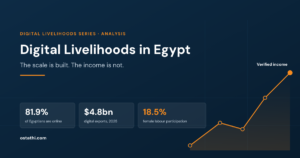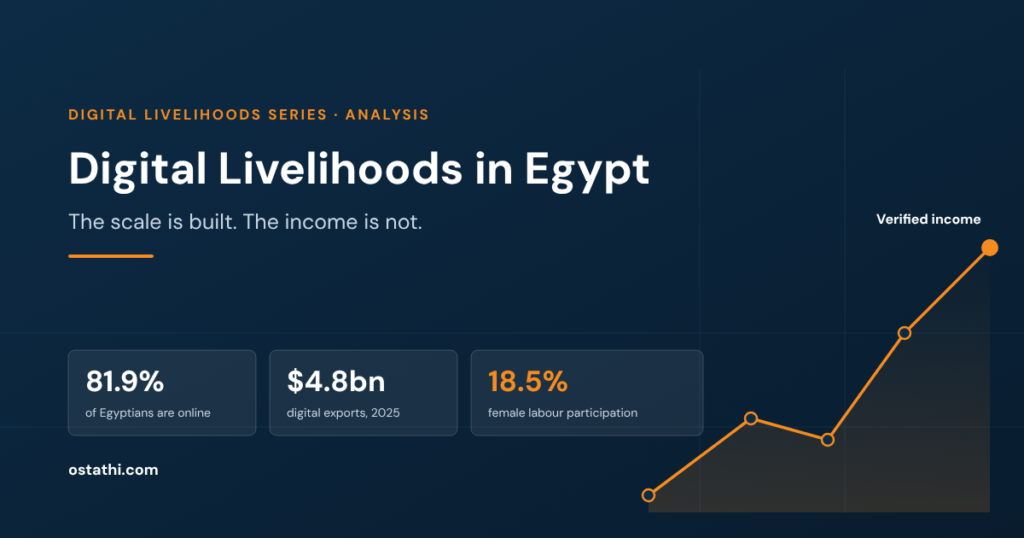
Egypt has done what most middle-income countries are still planning. It doubled its digital exports in three years, built an instant-payment network that processed more than a billion transactions in 2024, and became the rare government that names freelancing in its industrial strategy. Yet the average Egyptian web developer on the leading global work platform earns a fraction of what an Indian counterpart earns, informality covers more than three in five workers, and nearly two in five young women with intermediate or higher education who seek work cannot find it. This analysis examines the gap between the infrastructure Egypt has built and the incomes it has yet to produce — and what closing that gap would require.
Egypt’s digital livelihoods question
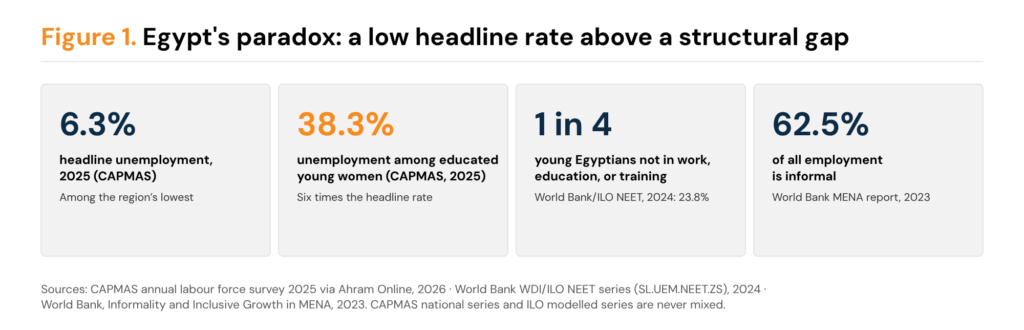
By the region’s usual measures, Egypt’s labour market looks like a success story. The national statistics agency, CAPMAS, reported unemployment of 6.3 per cent in 2025, down from 6.6 per cent a year earlier, with a labour force of 34.2 million people. Youth unemployment on the national series fell to 13.2 per cent. Few countries in the Middle East and North Africa can show a headline chart that slopes so consistently in the right direction.
The question this analysis asks is what the headline rate conceals. Of Egypt’s 34.2 million labour-force participants, only 7.5 million — 21.9 per cent — are women, on CAPMAS figures; female labour force participation stands at 18.5 per cent of the female population on the ILO’s separate modelled series, among the lowest recorded anywhere in the world. Unemployment among young people with intermediate, university, or higher qualifications stood at 16.8 per cent in 2025 — and at 38.3 per cent for women against 10.1 per cent for men, on CAPMAS’s own figures. Nearly one in four young Egyptians is not in employment, education, or training. And 62.5 per cent of all employment is informal — work without contracts, social insurance, or a verifiable income record: higher than Tunisia, and behind only Morocco among the three North African economies the World Bank compared.
In other words: Egypt does not have an unemployment problem in the way the headline number frames it. It has an income-quality problem, a participation problem, and a verification problem. Millions of Egyptians work; far fewer can prove what they earn, insure it, borrow against it, or grow it. That distinction — between having work and having a livelihood — is where the digital economy becomes decisive, because Egypt has spent a decade building digital infrastructure at a pace few of its peers have matched. The question is why the infrastructure has not yet produced the incomes.
What is a digital livelihood?
Across this series, a digital livelihood is defined as a sustained, verifiable income earned through digital channels — freelance services delivered to clients abroad, products sold through online marketplaces, skills converted into paid work through platforms rather than through wasta or queues. It is distinct from digital employment (a salaried job in a technology firm) and from digital access (owning a smartphone). The defining test is whether an individual can move from learning a skill to earning a recorded, bankable income from it — what this series calls the learn-to-earn transition.
The global market for such work is large and growing: the World Bank has estimated online gig work at up to 435 million people worldwide, and demand for remote digital services has expanded steadily as firms in high-income economies contract out development, design, data, and administrative work. The previous analyses in this series examined that transition in Jordan, where a national prototype is being built; in Iraq, where the state-employment model has reached its fiscal limits; and in Morocco, a producing economy whose individual earners lack a platform layer altogether. Egypt presents the opposite configuration to Morocco — and in some ways the most instructive case in the series.
The labour market behind the headline rate
Two series describe Egyptian youth unemployment, and this analysis keeps them separate throughout. CAPMAS’s national series (ages 15–29) recorded 13.2 per cent in 2025, down from 14.9 per cent in 2024, with the 20–24 band highest at 16.9 per cent. The ILO’s modelled series (ages 15–24), harmonised for international comparison, recorded 18.3 per cent in 2025 — higher than the year before. The two use different age bands and methodologies and are never combined in this analysis; what matters is that both agree on the structure beneath the average: unemployment in Egypt rises with education, and it rises most for educated women.
That pattern — graduate unemployment multiples above the national rate — is the signature of an education-to-employment pathway that produces credentials faster than the formal economy produces jobs that use them. Egypt graduates more than 750,000 university students a year. The formal private sector, squeezed by years of macroeconomic adjustment, absorbs a fraction. The traditional pressure valve — public-sector hiring — closed years ago. What remains is the informal economy, which absorbs the majority of new entrants and strips them of exactly the things a livelihood requires: contracts, social insurance, and an income that can be proven to anyone.
The female dimension deserves its own sentence, because it is the starkest in the region. A female participation rate of 18.5 per cent, urban female unemployment of 22.5 per cent, and educated-youth unemployment of 38.3 percent among women describe a labour market in which the fastest-growing educated cohort faces the narrowest set of acceptable, safe, and reachable work options. Remote digital work — performed from home, paid into an account the earner controls — is one of the few channels that fits the constraint, which is why women’s participation recurs throughout this analysis rather than in a section of its own.
The built pathway: offshoring’s decade
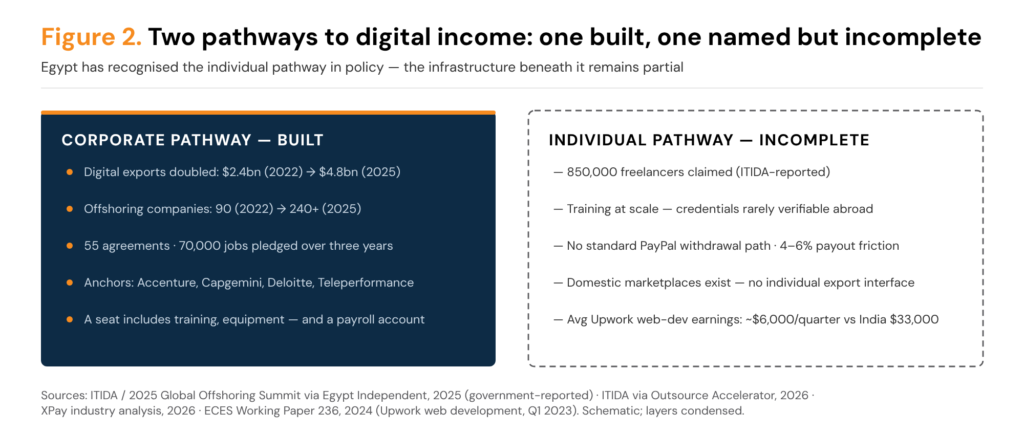
Egypt’s answer to the graduate surplus has been deliberate, funded, and — on its own terms — remarkably successful. The state’s IT industry agency, ITIDA, positioned Egypt as a global delivery hub: digital and offshoring exports doubled from $2.4 billion in 2022 to $4.8 billion in 2025, on government figures, while the number of international offshoring companies operating in Egypt grew from 90 to more than 240. At the 2025 Global Offshoring Summit in Cairo, 55 agreements with firms including Accenture, Capgemini, Deloitte, and Teleperformance were announced, projected to create 70,000 jobs over three years.
The comparison that best conveys the scale: in 2024, revenues from the Suez Canal — for half a century the emblem of Egypt’s position in the world economy — fell to $4 billion as Red Sea tensions cut transits by half, on the Canal Authority’s own figures. Egypt’s digital services exports in 2025 exceeded that. An economy whose geography was its rent is watching its talent become one.
This is the corporate pathway, and it mirrors what the Morocco analysis found in Casablanca’s offshoring parks: the state can build employer-mediated digital export industries, and does. A young Egyptian who secures a seat at a multinational delivery centre steps into a built corridor — recruitment pipeline, training, equipment, a payroll account, a verifiable salary. The corridor works. It is also narrow: 70,000 pledged jobs over three years, against more than 750,000 graduates a year and a NEET population in the millions. The arithmetic is not a criticism of the strategy; it is the reason a second pathway matters.
The second pathway Egypt already named
Here Egypt diverges from every other country in this series so far: the state has already recognised the individual pathway. ITIDA reports 850,000 active digital freelancers and describes freelancing as contributing more than 6 per cent of GDP — figures that are agency-reported and not independently verified, but that mark something the Jordan, Iraq, and Morocco analyses could not record: a government that counts its freelancers and claims them in its export strategy. Programmes such as Egypt FWD and ITIDA Gigs train for and route toward platform work; the Ministry of Communications’ Digital Egypt Generations initiative has set a goal of training 800,000 people in digital skills in 2026 alone.
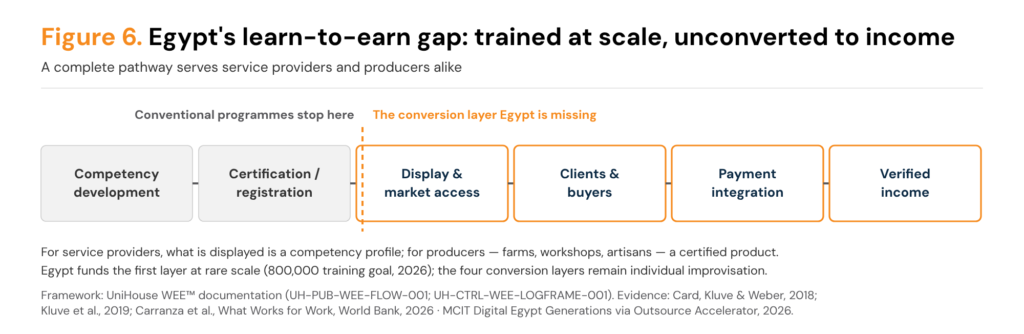
Recognition is not the same as infrastructure. Naming freelancers in a strategy, and even training them at scale, addresses the first layer of a livelihood pathway — competency development — and leaves the remaining layers where they were. The freelancer who completes an Egypt FWD track still faces the same market-access, verification, payment, and income-proof gaps as before the training. The sections that follow measure each of those gaps, because Egypt’s own data — more abundant than any other country in this series — makes them unusually visible.
A producing economy that already exports
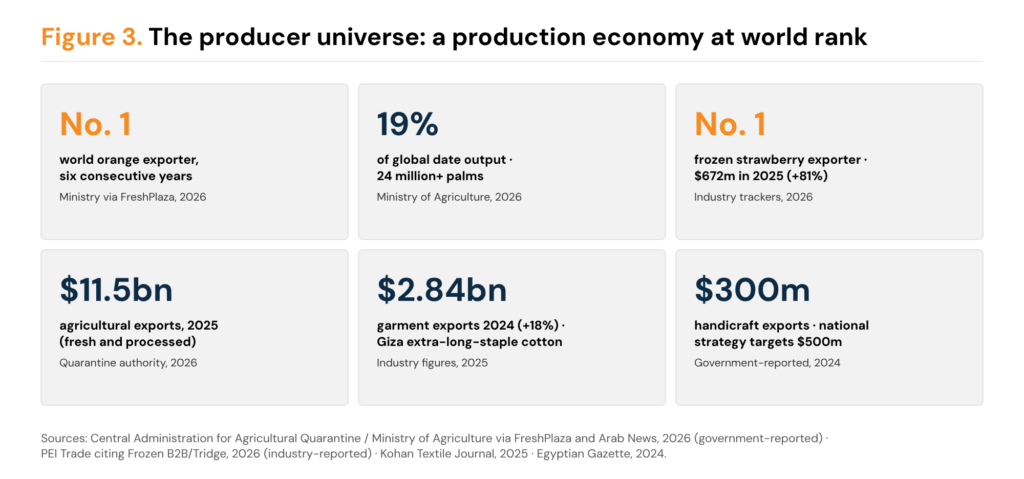
The digital livelihoods conversation defaults to services — code, design, data. Egypt’s case widens it, because Egypt is not merely a talent economy; it is one of the developing world’s most successful product exporters. Egypt has been the world’s largest orange exporter for six consecutive years, ahead of Spain and South Africa, with citrus shipments exceeding 2.2 million tonnes in 2025. It is the world’s largest producer of dates — around 2 million tonnes a year, 19 per cent of global output, from more than 24 million palms, on Ministry of Agriculture figures. It became the world’s top exporter of frozen strawberries, with industry trackers recording roughly $672 million in 2025, up 81 per cent in a year. Total agricultural exports, fresh and processed, surpassed $11.5 billion in 2025 on quarantine-authority figures.
The production base extends far beyond the farm gate. The textile and garment sector — heir to Egypt’s extra-long-staple Giza cotton — employs several hundred thousand workers across thousands of firms, with garment exports of $2.84 billion in 2024, up 18 per cent, on industry figures. The governorate of Damietta is a place whose economy is organised around furniture: government accounts describe a local population the large majority of which works wood. Handicrafts — ceramics, jewellery, textiles, leather — export roughly $300 million a year, a figure the national handicrafts strategy aims to lift to $500 million.
Set those numbers beside each other and the pattern from the Morocco analysis reappears in a richer form. Egypt’s export success is real — and it is overwhelmingly aggregated. Oranges leave through large exporters with quarantine certification and cold chains. Garments leave through factories filling foreign purchase orders. The individual producer — the date farmer among 24 million palms, the Damietta workshop, the artisan whose ceramics reach a Cairo bazaar but not a Berlin browser — participates in the export economy as an input, not as a seller. The value of a national brand six years atop the world orange trade accrues to the aggregation layer. Almost none of it reaches a producer as a direct, digitally-mediated, verifiable income.
The platform layer Egypt has — and the layer it lacks
In Morocco, this series found a producing economy with almost no marketplace infrastructure: no Amazon presence, roughly 5,000 merchant websites in the entire country. Egypt is different, and the difference sharpens the diagnosis. Egypt has marketplaces: Amazon operates Amazon.eg, Noon anchors the regional market alongside it, Jumia and omnichannel retailers compete beneath them. Business-to-consumer e-commerce reached roughly $9.9 billion in 2025 on industry databook estimates and is projected to approach $14.5 billion by 2029. More than 35 million Egyptians shop online at least quarterly, on industry research figures.
So the marketplace explanation for exclusion — the one that fits Morocco — does not fit Egypt. What Egypt lacks sits one layer deeper, in three places. First, the payment layer under the marketplaces is still cash: industry research puts cash on delivery at 60–70 per cent of online orders, rising outside Cairo and Alexandria. A cash-settled order produces no income record for the seller, no purchase protection for the buyer, and no data trail that a bank, insurer, or platform can underwrite. Egypt has marketplaces; it does not yet have marketplace-grade trust rails reaching most of its participants.
Second, the domestic platforms do not export. Amazon.eg and Noon serve Egyptian demand in Egyptian pounds. The producer who lists on them reaches Cairo, not the diaspora premium or the European organic market. The interface that would let a Damietta workshop or a Fayoum pottery sell outward — listings in foreign languages, cross-border payment collection, export logistics at parcel scale — is the layer that does not exist, and it is the same missing layer the Morocco analysis identified, merely one storey higher in an otherwise taller building.
Third, producers are largely absent even from the domestic layer. The marketplaces are dominated by traders and brands, not by the production economy: the farmer, cooperative, and workshop sell into aggregators offline, at aggregator prices, exactly as they did before the marketplaces arrived. Egypt’s e-commerce growth is, so far, a distribution revolution for existing commerce — not yet a market-access revolution for its producers.
Payments: the fastest-moving layer
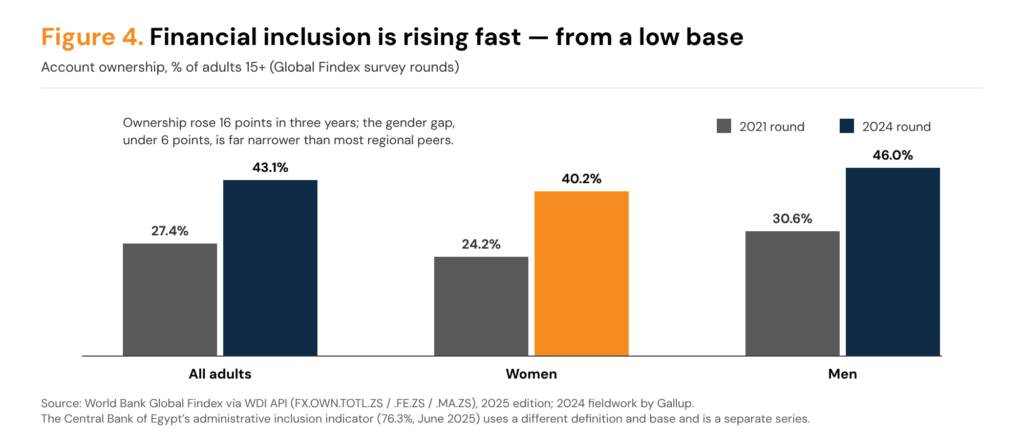
If the platform layer is Egypt’s half-built storey, payments are the storey where construction is visibly succeeding — and the arc matters because it shows what deliberate infrastructure policy achieves. On the World Bank’s Global Findex — the independent, survey-based international series — account ownership among Egyptian adults rose from 27.4 per cent in 2021 to 43.1 per cent in 2024, an unusually large three-year gain. The gender gap, at 40.2 per cent for women against 46.0 per cent for men, is under six percentage points — where Morocco’s, for comparison, is twenty. The Central Bank of Egypt’s own inclusion measure — a broader definition covering bank, postal, and wallet accounts among citizens sixteen and older, and therefore never comparable with Findex — stood at 76.3 per cent in mid-2025, from 27.4 per cent in 2016, on central-bank figures.
Behind both series sits real usage, not dormant accounts. InstaPay, the consumer face of the instant payment network launched in 2022, reached more than 16 million users and processed 1.1 billion transactions worth EGP 2.4 trillion in 2024; mobile wallets processed 1.4 billion more, on central-bank figures. And the single most convincing proof that Egypt’s rails can carry livelihood-scale flows is the remittance record: $43 billion in the first eleven months of fiscal year 2025/26, up roughly a third year on year — a surge attributed in reporting of the central-bank figures largely to the unification of exchange rates, which pulled transfers out of informal channels and into the banking system. When the price is right and the rail is trusted, Egyptian income moves formally, at extraordinary scale, within a single year. The behaviour is not the constraint. The design is.
Egypt’s fintech layer: who moves the money
A reader weighing Egypt’s digital payment landscape should know the named infrastructure, because it is substantial. Fawry, founded in 2008, is the country’s ubiquitous payment network: more than 300,000 service points, 54.1 million customers as of mid-2025, and around six million transactions a day, on company-reported figures — Egypt’s second-largest listed fintech, valued above $1 billion. Paymob, founded 2015, is the leading merchant gateway, serving more than 390,000 merchants with over 60 payment methods and expanding across the Gulf, on company figures. Beneath them run the central bank’s rails described above — InstaPay for instant transfers, Meeza for cards and wallets — and around them a sector that grew from 32 to 177 fintech companies between 2017 and 2022, on industry figures.
The composition of that list is itself the finding. Every major player solves collection or domestic transfer: paying a bill, accepting a card, moving pounds between Egyptian accounts. None of them solves the individual’s inbound cross-border payout — the transaction on which a freelancer’s or micro-exporter’s livelihood depends. Egypt’s fintech sector is deep where domestic commerce needed it, and thin exactly where the digital livelihoods pathway needs it next — the gap the following section measures.
The payout gap that caps freelance income
Every layer described so far serves domestic flows. The layer that serves the freelancer’s defining transaction — being paid from abroad — remains the weakest, and it is weak in a specifically Egyptian way. PayPal, the default payment expectation of small international clients, allows Egyptians to open accounts and to pay outward; industry guides are unambiguous that there is no standard supported path to withdraw a balance to an Egyptian bank account in pounds. The practical result is a workaround economy: earnings routed through Payoneer or Wise, effective costs that industry analyses put at 4–6 per cent per transaction, balances held offshore, and — for the less experienced — earnings stranded or lost to grey-market conversion.
The macro history explains the caution. Egypt spent much of 2022–2024 managing an acute foreign-currency shortage and a wrenching exchange-rate adjustment under an $8 billion IMF Extended Fund Facility whose seventh review was agreed at staff level in June 2026. A central bank that fought for every dollar of formal inflow was never likely to liberalise small-ticket outbound-linked services quickly. But the remittance record shows the same institution has now proven the opposite motion at scale: after rates unified, $43 billion moved through formal channels in eleven months. The policy question is whether freelance and micro-export earnings — structurally identical to remittances as foreign-currency inflows earned by individual Egyptians — will be given rails of the same quality. Today they are taxed by friction that remittances no longer pay.
The conversion problem: presence without income
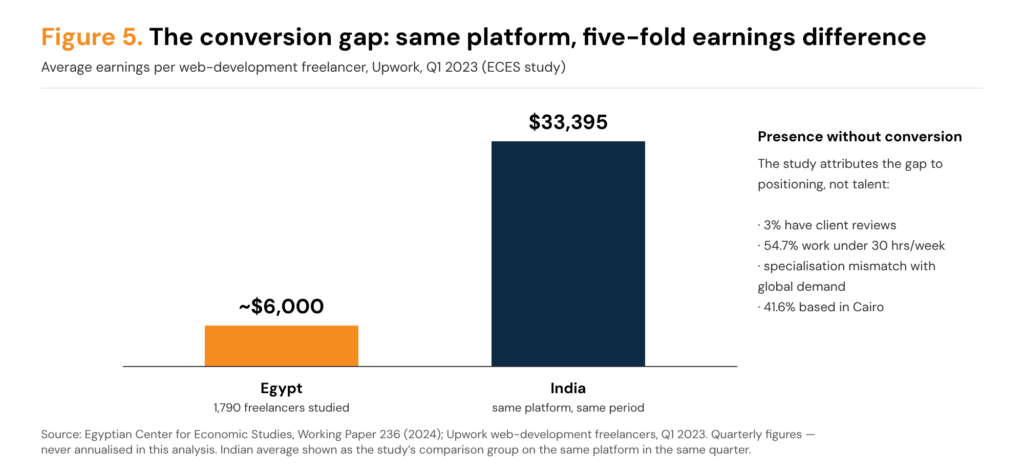
The most precise evidence in this analysis comes from a study by the Egyptian Center for Economic Studies of Egyptian web-development freelancers on Upwork, one of the largest global work platforms. In the quarter examined, 1,790 Egyptian web developers earned a combined $10.6 million — an average of roughly $6,000 per freelancer, against an average of $33,000 for their Indian counterparts on the same platform, in the same period, selling nominally the same services. The study’s diagnosis was not talent but positioning: Egyptian freelancers clustered in lower-value specialisations relative to demand, worked fewer paid hours, and under-invested in the signals — reviews, portfolios, niche depth — that platforms convert into price.
That five-fold earnings gap is the entire argument of this pillar in a single statistic. Egypt has presence: 850,000 freelancers on the agency’s count, more than 96 million people online, an internet penetration rate of 81.9 per cent. What it lacks is conversion — the machinery that turns presence into rising per-person income: specialisation guidance driven by market data, credentials a foreign client can verify, payment rails that do not surrender 4–6 per cent and a week of delay, and an income record that accumulates somewhere an Egyptian bank can read. Scale without conversion produces exactly what the data shows: many participants, thin earnings, and a fatigue narrative — “freelancing does not pay” — that is true only of freelancing as currently plumbed.
Why training alone will not convert scale into income
Egypt’s instinct, like most states’, is to answer the gap with training: 800,000 people in 2026 under Digital Egypt Generations, on ministry figures. The international evaluation evidence, examined at length in this series’ analysis of workforce activation, is consistent: skills programmes alone deliver small average employment effects, because they strengthen the supply of capability while leaving untouched the demand-side and infrastructure layers — market access, matching, payment, proof — through which capability becomes income. Egypt is, in effect, running a natural experiment in this finding at rare scale: it trains at a scale few states match, hosts one of the region’s largest claimed freelance workforces, and still records per-freelancer earnings a fifth of the Indian benchmark on the same platform.
The same critique applies to the product side, where the instrument of choice is promotion rather than training. The national handicrafts strategy aims to lift exports from $300 million to $500 million, and its visible instruments — the Turathna exhibitions, the Herafi programme, export-council fairs — are episodic by design: an artisan sells for four days in a Cairo hall, then returns to invisibility. Exhibitions create moments of demand; they do not create the standing infrastructure — storefront, payment, logistics, reputation — that converts a craft into a continuous export business. Egypt’s fairs, like Morocco’s, are the product-economy equivalent of a training certificate: necessary, sincere, and structurally incomplete.
What a complete pathway requires
Drawing the threads together: a functioning individual pathway — for a freelance developer in Mansoura or a leather workshop in Old Cairo alike — requires six layers, each present for Egypt’s corporate exporters and absent or partial for its individuals. Competency development, which Egypt funds at scale. Verifiable credentials, which its training programmes rarely issue in machine-readable, internationally-legible form. Market access — standing storefronts and profiles that reach foreign demand, not domestic marketplaces alone. Matching and first clients, the cold-start problem every platform economy must solve deliberately. Payment integration, meaning collection from foreign payers at remittance-grade cost and reliability. And verified income — the recorded, cumulative earnings history that converts work into creditworthiness, insurability, and formality. Egypt has built the first layer, half-built the fifth, and left the middle of the pathway — where income is actually created — to individual improvisation.
The informality statistic makes the last layer decisive. In an economy where 62.5 per cent of employment is informal, verified income is not an administrative nicety; it is the difference between a workforce the state can see, insure, and tax fairly, and one it cannot. The Cabinet’s February 2026 MSME law amendments — offering unlicensed firms a year-long window to regularise — recognise the problem from the legal side. Digital earnings infrastructure recognises it from the economic side: a freelancer or seller whose income arrives recorded is formal by construction, not by enforcement.
The Jordan reference implementation
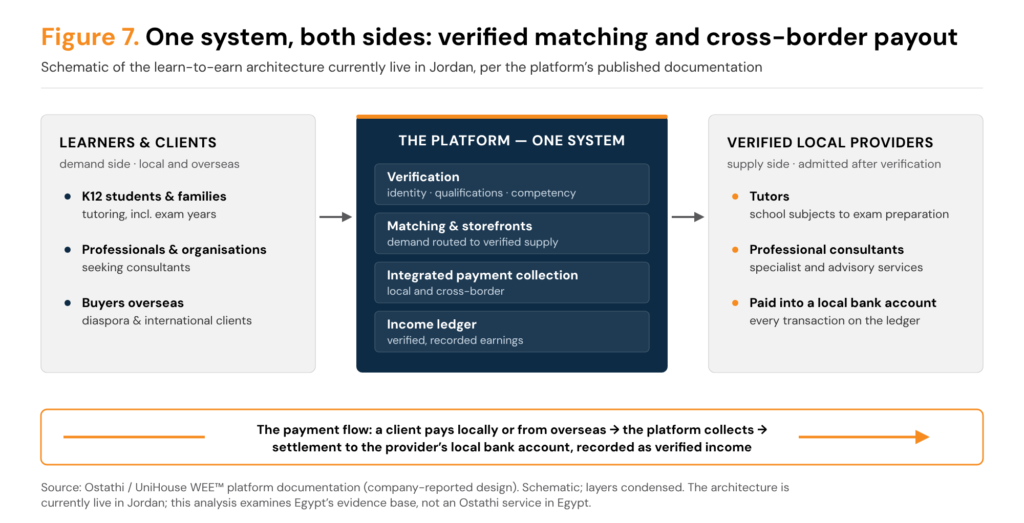
The practical question is whether the missing layers can be built as one system rather than as disconnected programmes. The nearest working reference is in Jordan, where Ostathi — a learn-to-earn platform developed by UniHouse and backed by Microsoft for Startups, currently live in Jordan — operates the full pathway as a single architecture: competency development tied to market demand, credentialing, storefronts and client matching, integrated payment collection, and an income ledger that records what each participant verifiably earned.
Two design choices in that architecture speak directly to the gaps this analysis has measured. First, it is built for both sides of the market: learners — from school students seeking tutoring to individuals and organisations seeking professional consultants — are matched with local tutors and consultants who are admitted only through a structured verification process covering identity, qualifications, and demonstrated competency, per the platform’s published documentation. Second, payment is integrated across borders by design: a client overseas pays through the platform, and the tutor or consultant receives settlement into a local bank account, at costs designed to compare with remittance channels rather than the 4–6 percent workaround economy described above, with every transaction recorded in the income ledger. Trust in the provider and payout to the provider — the two constraints that cap individual earnings in Egypt’s own data — are addressed inside one system rather than as separate programmes. Its design detail most relevant to Egypt: in the platform’s early operating data, the majority of transaction value settled from buyers outside the country — company-reported, as of mid-2026 — evidence that when the pathway is complete, individual earners in a mid-income Arab economy sell outward by default. The Jordan experience is examined in the first analysis in this series, and its measurement design in the activation framework analysis.
From analysis to implementation
Egypt’s configuration — pathways named, rails half-built, scale unmatched — makes it less a candidate for invention than for completion, and completion is the kind of work development institutions already finance. The instruments exist in-country: the World Bank and IMF anchor the macro framework; MSMEDA channels finance toward micro-enterprises, including through payment companies; the ILO, UNDP, and bilateral agencies run employment and inclusion programmes across the governorates. What the evidence in this analysis suggests is a re-aiming: from programmes that add more training to the front of the pathway, toward instruments that finance the middle of it — credential verification, cross-border payout access, first-client market entry, and income-ledger infrastructure — where each invested pound touches the layer that currently caps earnings. The Iraq analysis reached a parallel conclusion from the opposite starting point: whether a state has built too little infrastructure or almost all of it, the binding constraint converges on the same missing middle.
Implications for government and development partners
For the Egyptian government, three implications follow from its own data. First, the freelance payout gap is a foreign-currency policy issue wearing a labour-market disguise: a freelance workforce of the size ITIDA claims, earning anywhere near international benchmarks, would generate foreign-currency inflows of remittance-class significance — and every point of friction on those rails is revenue pushed offshore or into informality. Second, the female-participation crisis and the digital pathway are the same file: remote, home-based, verifiably-paid work is the channel most compatible with the constraints that keep 38.3 percent of educated young women jobless, and every layer completed in the pathway is likely to disproportionately benefit them. Third, the producer economy is an export policy blind spot: the state that made itself the world’s top orange exporter through aggregated trade has no dedicated instrument identified in this analysis aimed at the individual producer as a direct exporter — the segment where digital market access creates incomes rather than margins.
For development partners, Egypt offers what programme designers rarely get: a counterfactual at national scale. The country has already done what employment programmes usually recommend — trained massively, built payment rails, attracted platforms — and the per-person income data shows precisely which remaining layers bind. Instruments that fund verification, market entry, and payout infrastructure for individuals — rather than additional cohorts of training — would be testing the marginal layer, in the largest Arabic-speaking labour market, with a government already committed on the record to the freelance economy.
Conclusion: the conversion decade
Egypt’s last decade of digital policy built scale: exports doubled, account ownership up by more than half on the Findex series, a billion instant transactions, marketplaces, and a freelance workforce its government officially counts. The next decade’s returns will come from conversion — from the distance between $6,000 and $33,000 on the same platform, in the same quarter, for the same work. That distance is not talent, geography, or demand. It is infrastructure: the unglamorous middle layers of a livelihood pathway that no ministry currently owns and no training budget reaches. The countries examined in this series face versions of the same gap from different directions — Jordan building the full pathway deliberately, Iraq confronting it earliest, Morocco lacking the platform floor, Egypt lacking only the conversion machinery on top of an otherwise complete stack. Egypt, precisely because it has built the most, has the least excuse — and the most to gain.
Frequently asked questions
How many freelancers does Egypt have?
Egypt’s IT industry agency, ITIDA, reports about 850,000 active digital freelancers and describes freelancing as contributing more than 6 per cent of GDP. These are agency-reported figures; independent studies count far smaller populations on individual platforms (for example, roughly 1,800 Egyptian web-development freelancers active on Upwork in the quarter studied by ECES). The honest answer is that Egypt has one of the largest freelance workforces in the region by any count, and no independently verified total.
Why do Egyptian freelancers earn less than freelancers elsewhere?
The ECES study of Upwork data found Egyptian web developers averaging roughly $6,000 against an Indian average of about $33,000 in the quarter studied — attributable to specialisation mismatch with demand, fewer paid hours, weaker client-facing signals such as reviews and portfolios, and payment friction. None of these are talent deficits; all are infrastructure and positioning gaps that policy and platform design can address.
Can Egyptians receive PayPal payments?
Egyptians can open PayPal accounts and pay outward, but industry guides consistently document that there is no standard supported path to withdraw balances to Egyptian bank accounts in pounds. Most freelancers route earnings through alternatives such as Payoneer or Wise, at effective costs industry analyses put at 4–6 per cent.
Is Egypt’s financial inclusion 43 per cent or 76 per cent?
Both figures are real and measure different things. The World Bank’s Global Findex, an independent household survey of adults 15 and older, recorded 43.1 per cent account ownership in 2024. The Central Bank of Egypt’s own indicator, which covers citizens 16 and older and counts bank, postal, and mobile-wallet accounts from administrative data, recorded 76.3 per cent in mid-2025. This analysis cites each series by name and never combines them.
What is Egypt the world’s largest exporter of?
In agriculture, Egypt leads the world on several fronts: it has been the world’s largest orange exporter for six consecutive years, with citrus shipments above 2.2 million tonnes in 2025; it is the world’s top exporter of frozen strawberries, at roughly $672 million in 2025 on industry figures; and it is the world’s largest producer of dates, with about 19 percent of global output on Ministry of Agriculture figures. Total agricultural exports, fresh and processed, passed $11.5 billion in 2025. As this analysis documents, almost all of that trade flows through large aggregators rather than individual producers.
Can Egyptian producers and artisans sell their products internationally online?
Structurally, barely. Egypt’s domestic marketplaces — Amazon.eg, Noon, Jumia — serve Egyptian demand in Egyptian pounds and offer no standing export interface for an individual workshop or farm; cash on delivery still covers 60–70 per cent of online orders on industry research, which leaves sellers without income records; and handicraft exports, at roughly $300 million a year, move through aggregated trade and episodic exhibitions rather than direct digital channels. Building that individual export layer — storefronts, cross-border payment collection, parcel-scale logistics, verifiable seller records — is the platform gap this analysis identifies.
Is Ostathi operating in Egypt today?
No. Ostathi is currently live in Jordan, where the platform operates the learn-to-earn pathway described in this analysis. This Egypt analysis is part of a country-by-country research series on digital livelihoods across the region; it examines Egypt’s evidence base, not an Ostathi service in Egypt.
References
Ahram Online / CAPMAS (2026). Egypt unemployment rate drops to 6.3% in 2025. https://english.ahram.org.eg/NewsContent/1/2/566952/Egypt/Society/Egypt-unemployment-rate-drops-to–in–CAPMAS.aspx Accessed 6 September 2026.
World Bank (2023). Working Without Borders: The Promise and Peril of Online Gig Work. https://www.worldbank.org/en/news/press-release/2023/09/07/demand-for-online-gig-work-rapidly-rising-in-developing-countries Accessed 6 September 2026.
World Bank Data / ILO modelled estimates (2026). Youth unemployment (15–24), Egypt (SL.UEM.1524.ZS). https://data.worldbank.org/indicator/SL.UEM.1524.ZS?locations=EG Accessed 6 September 2026.
World Bank Data / ILO modelled estimates (2026). Female labour force participation (15+), Egypt (SL.TLF.CACT.FE.ZS). https://data.worldbank.org/indicator/SL.TLF.CACT.FE.ZS?locations=EG Accessed 6 September 2026.
World Bank Data (2026). Share of youth not in education, employment or training, Egypt (SL.UEM.NEET.ZS). https://data.worldbank.org/indicator/SL.UEM.NEET.ZS?locations=EG Accessed 6 September 2026.
World Bank (2023). Informal employment in Egypt, Morocco and Tunisia — Arab Voices blog, citing ‘Informality and Inclusive Growth in MENA. https://blogs.worldbank.org/en/arabvoices/informal-employment-egypt-morocco-tunisia-what-can-we-learn-boost-inclusive-growth Accessed 6 September 2026.
Ahram Online (2026). IMF upgrades Egypt’s 2026 growth as seventh EFF review advances. https://english.ahram.org.eg/News/572441.aspx Accessed 6 September 2026.
AGBI (2026). Gulf-based Egyptians push remittances to record high (Central Bank of Egypt figures). https://www.agbi.com/economy/2026/07/gulf-based-egyptians-push-remittances-to-record-high/ Accessed 6 September 2026.
Ahram Online (2024). Suez Canal revenues plummet to $4bn in 2024 — SCA chairman. https://english.ahram.org.eg/NewsContent/3/12/537710/Business/Economy/Suez-Canal-revenues-plummet-to–bln-in–amid-Red-S.aspx Accessed 6 September 2026.
DataReportal / Kepios (2026). Digital 2026: Egypt. https://datareportal.com/reports/digital-2025-egypt Accessed 6 September 2026.
Egypt Independent (2025). Egypt doubles digital offshoring exports to $4.8bn, secures 70,000 jobs (ITIDA, Global Offshoring Summit). https://egyptindependent.com/egypt-doubles-digital-offshoring-exports-to-4-8b-secures-70000-jobs-in-major-global-summit/ Accessed 6 September 2026.
Outsource Accelerator (2026). Egypt’s ITIDA puts freelancers at the heart of offshoring push. https://news.outsourceaccelerator.com/egypt-itida-freelancers/ Accessed 6 September 2026.
Outsource Accelerator (2026). Egypt to train 800K tech workers in 2026 (Digital Egypt Generations). https://news.outsourceaccelerator.com/egypt-train-800k-tech-workers/ Accessed 6 September 2026.
Egyptian Center for Economic Studies (2024). Freelancing Landscape in Egypt, Working Paper 236 (Upwork Q1 2023 data). https://eces.org.eg/wp-content/uploads/2024/04/W-P-En-236.pdf Accessed 6 September 2026.
World Bank Global Findex via World Bank Data (2025). Account ownership, Egypt, total/female/male (FX.OWN series). https://data.worldbank.org/indicator/FX.OWN.TOTL.ZS?locations=EG Accessed 6 September 2026.
Daily News Egypt (2025). CBE’s digital transformation push lifts financial inclusion to 76.3% in June 2025 (central-bank figures). https://www.dailynewsegypt.com/2025/11/17/cbes-digital-transformation-push-lifts-financial-inclusion-to-76-3-in-june-2025-assistant-governor/ Accessed 6 September 2026.
Egyptian Streets (2026). Inside Egypt’s InstaPay economy. https://egyptianstreets.com/2026/01/04/inside-egypts-instapay-economy-how-instant-payments-are-changing-access-for-a-new-generation/ Accessed 6 September 2026.
XPay (2026). PayPal in Egypt: the honest answer + alternatives (industry analysis). https://xpay.app/blog/paypal-egypt-alternatives Accessed 6 September 2026.
FreshPlaza / Egypt Today (2026). Egypt’s citrus exports exceed 2.2 million tonnes in 2025; agricultural exports surpass $11.5bn (Central Administration for Agricultural Quarantine). https://www.freshplaza.com/north-america/article/9822152/egypt-s-citrus-exports-exceed-2-2-million-tons-in-2025/ Accessed 6 September 2026.
Arab News (2026). Egypt accounts for 19% of global date output (Ministry of Agriculture). https://www.arabnews.com/node/2632333/ Accessed 6 September 2026.
PEI Trade (2026). Egypt #1 in frozen strawberry exports: $672m in 2025 (industry trackers). https://peitrade.com/egypt-frozen-strawberry-exports-672-million-2025/ Accessed 6 September 2026.
Kohan Textile Journal (2025). Egypt textile industry 2025 (industry figures). https://kohantextilejournal.com/egypt-textile-industry-2025/ Accessed 6 September 2026.
African Development Bank (n.d.). Egypt: the furniture industry generates jobs and wealth in Damietta. https://www.afdb.org/en/news-and-events/egypt-furniture-industry-generates-jobs-and-wealth-damietta-34903 Accessed 6 September 2026.
Egyptian Gazette (2024). Strong state support for the handicrafts industry (national strategy, Herafi, Turathna). https://egyptian-gazette.com/egypt/strong-state-support-for-the-handicrafts-industry/ Accessed 6 September 2026.
GlobeNewswire / ResearchAndMarkets (2026). Egypt B2C Ecommerce Databook 2025. https://www.globenewswire.com/news-release/2026/01/29/3228289/0/en/Egypt-B2C-Ecommerce-Databook-Report-2025-A-14-53-Billion-Market-by-2029-Amazon-and-Noon-Anchor-Marketplaces-While-B-TECH-Carrefour-Egypt-and-Jumia-Leverage-Omnichannel-Control.html Accessed 6 September 2026.
TechCabal (2026). How Egypt’s Fawry built a $1 billion fintech (company-reported figures). https://techcabal.com/2026/04/20/how-fawry-built-a-profitable-fintech/ Accessed 20 October 2026.
Dealroom (2026). Egypt’s Paymob raises $35M as GCC revenue jumps sevenfold (company-reported figures). https://dealroom.co/news/155044-egypts-paymob-raises-35m-as-gcc-revenue-jumps-sevenfold/ Accessed 20 October 2026.
CODRocket Research (2026). Egypt e-commerce statistics & trends (cash-on-delivery share, industry estimates). https://codrocket.com/blog/egypt-ecommerce-statistics-trends-2026 Accessed 6 September 2026.
Amwal Al Ghad (2026). Egypt’s Cabinet approves MSME law amendments, offers path for informal firms. https://en.amwalalghad.com/egypts-cabinet-approves-msme-law-offers-path-for-informal-firms/ Accessed 6 September 2026.
Methodology note
This analysis distinguishes throughout between statistical series that measure related phenomena differently: CAPMAS national labour statistics (youth defined as 15–29) and ILO modelled estimates (15–24); the World Bank Global Findex survey (adults 15+) and the Central Bank of Egypt’s administrative financial-inclusion indicator (citizens 16+); and ITIDA’s agency-reported export and freelancer figures alongside independent platform studies. Series are labelled at each use and never combined. Government-reported and company-reported figures are attributed as such. Where a claim could not be verified against an accessible primary or reputable secondary source, it was excluded. All references were accessed on 6 September 2026.