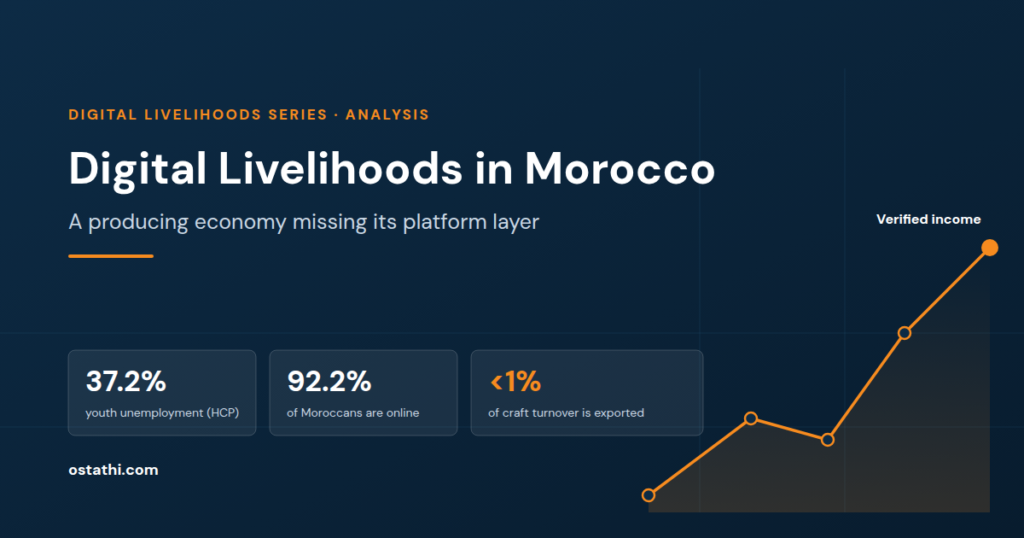
Morocco is the Middle East and North Africa’s most instructive contradiction: an economy posting its strongest growth in a decade, exporting cars, aircraft parts, tomatoes, and fish at world rank — while a third of its young people sit outside work and education, and its 1.6 million farms, 65,000 cooperatives, and hundreds of thousands of artisans remain largely unable to display, sell, and be paid in digital markets. This analysis, fourth in the Digital Livelihoods series, examines what the evidence says Morocco requires.
Morocco’s digital livelihoods question
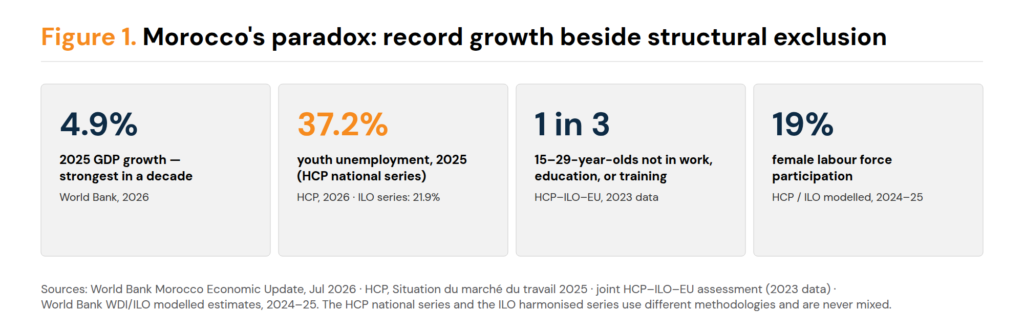
In 2025 Morocco recorded its strongest economic growth in ten years — 4.9 per cent, with inflation below one per cent (World Bank, 2026). In the same year, youth unemployment on the national series rose to 37.2 per cent (HCP, 2026). That pairing is not a statistical accident; it is the country’s structural signature. The World Bank’s latest jobs diagnostic puts it plainly: between 2000 and 2024, Morocco’s working-age population grew two and a half times faster than employment (World Bank, 2026). Growth, on its own, has not been hiring — and for a quarter of a century, it has not needed to.
This analysis applies to Morocco the frame developed across this series — in Jordan, where the model is deployed, and Iraq, where connectivity outran infrastructure — and extends it. A digital livelihood is an income stream generated through digitally delivered work or digitally mediated trade: competencies converted into services sold to clients anywhere, or products displayed, sold, and settled through digital channels. Morocco’s distinction is that it needs both halves of that definition at once. It has a services story — a young, trilingual, connected population — and, unusually for this series, a products story: one of the region’s great producing economies, still trading almost entirely offline.
A labour market that growth alone cannot fix
The headline numbers understate the exclusion. National unemployment fell to 13.0 per cent in 2025 — while youth unemployment rose (HCP, 2026). Broad labour underutilisation stands at 22.5 per cent (World Bank, 2026). Unemployment among diploma holders stood at 19.1 per cent, and underemployment at 10.9 per cent (HCP, 2026). A joint assessment by HCP, the ILO, and the European Union found 33.6 per cent of Moroccans aged 15 to 29 — some 2.9 million people — neither in employment nor in education or training in 2023, more than 72 per cent of them young women (HCP–ILO–EU via Morocco World News, 2026). Female labour force participation stands at roughly 19 per cent — a level the World Bank describes as among the lowest in the world (World Bank WDI, 2025; World Bank, 2026).
Two features shape what any response must look like. First, informality: 77.3 per cent of Moroccan employment is informal — higher than Egypt or Tunisia (World Bank, 2023). Second, geography: unemployment is an urban, educated phenomenon — 16.4 per cent in cities against 6.6 per cent in the countryside, where low measured unemployment conceals agricultural underemployment (HCP, 2026). The rural economy is meanwhile shedding the jobs it had: agriculture lost 137,000 positions between 2023 and 2024 alone (HCP, 2025). People are leaving the land faster than the cities can absorb them.
A demographic window that is closing, not opening
Morocco’s demography sets it apart from the rest of this series. Where Iraq’s youth bulge is still growing, Morocco’s has peaked. The 2024 census counted 36.8 million people, with annual growth decelerated to 0.85 per cent (HCP census, 2024). Official projections show the 18-to-24 cohort declining from here to 2060, while the population aged 60 and over doubles to roughly a quarter of the total (HCP projections, 2026). The policy meaning is stark: every year in which a large young cohort remains excluded is a year of a closing window, not a waiting asset. The exit option is already being exercised — 28 per cent of Moroccans aged 18 to 35 report thinking “a lot” about emigrating, up from 20 per cent in 2017 (Afrobarometer, 2025). Digital livelihoods, in this frame, are a talent-retention infrastructure: a way for income from anywhere to reach people who stay.
Connectivity is solved; conversion is not
As in every market this series has examined, the connectivity argument is over. Internet penetration reached 92.2 per cent — 35.5 million users — by late 2025 (DataReportal, 2026); the national regulator counts 39.9 million internet subscriptions, 92 per cent of them mobile (ANRT via Le Matin, 2025). The state has codified its ambition in Digital Morocco 2030, which targets 240,000 direct digital jobs and the training of more than 100,000 people by the end of the decade — targets, it should be noted, not yet outcomes (CGEM, 2024). What connectivity has not yet done is convert: fewer than one in five Moroccan firms makes intensive use of advanced technologies, and the World Bank estimates that closing the digitalisation gap could raise aggregate productivity by 10 to 15 per cent — noting that firms which digitalise intensively show productivity gains of up to 70 per cent, grow employment 10 per cent faster, and pay wages roughly 27 per cent higher (World Bank, 2026).
The two pathways: corporate success, individual exclusion
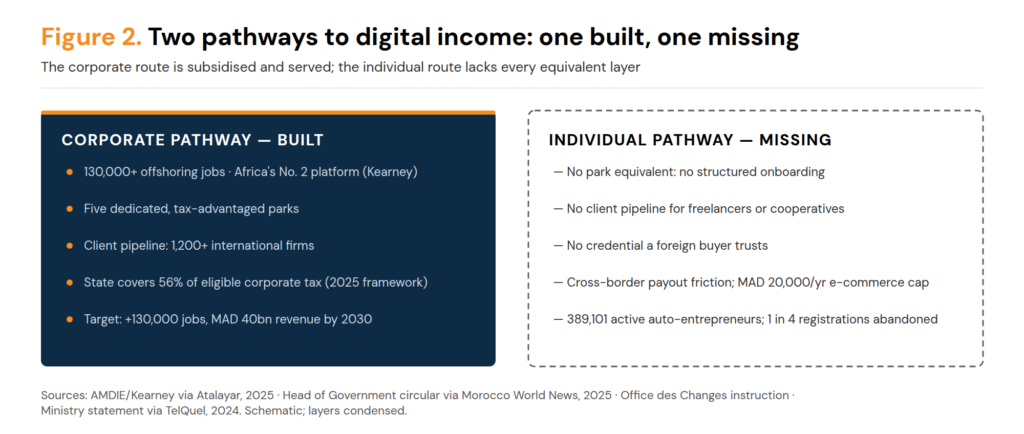
Here Morocco diverges from every other market in this series — because Morocco has already proven, at industrial scale, that its people can sell digital services to the world. The offshoring sector employs more than 130,000 people across five dedicated parks from Casablanca to Oujda, serves more than 1,200 international client companies, and generates export revenue that Morocco’s investment agency reports at roughly US$1.9 billion; Kearney ranks Morocco Africa’s second outsourcing platform (AMDIE/Kearney via Atalayar, 2025). The state is doubling down: a November 2025 incentive framework targets 130,000 additional offshoring jobs by 2030, with the treasury covering more than half of eligible firms’ corporate tax (Morocco World News, 2025).
So the question is not whether Moroccans can earn digitally — tens of thousands already do, inside company walls. The question is why the same capability stops at the company gate. The individual pathway — the freelancer, the independent professional, the cooperative selling under its own name — lacks nearly everything the corporate pathway enjoys: no tax-subsidised park, no client pipeline, no payment rail built for cross-border receivables, no credential a foreign buyer trusts. The best available proxy for formalised independent work is the auto-entrepreneur register: 389,101 active as of late 2024 — against 641,409 who ever applied, of whom 133,317 have since deregistered (Ministry statement via TelQuel, 2024). A regime exists; a pathway does not. That churn is what an unsupported journey from registration to sustained income looks like in administrative data.
A producing economy missing its platform layer
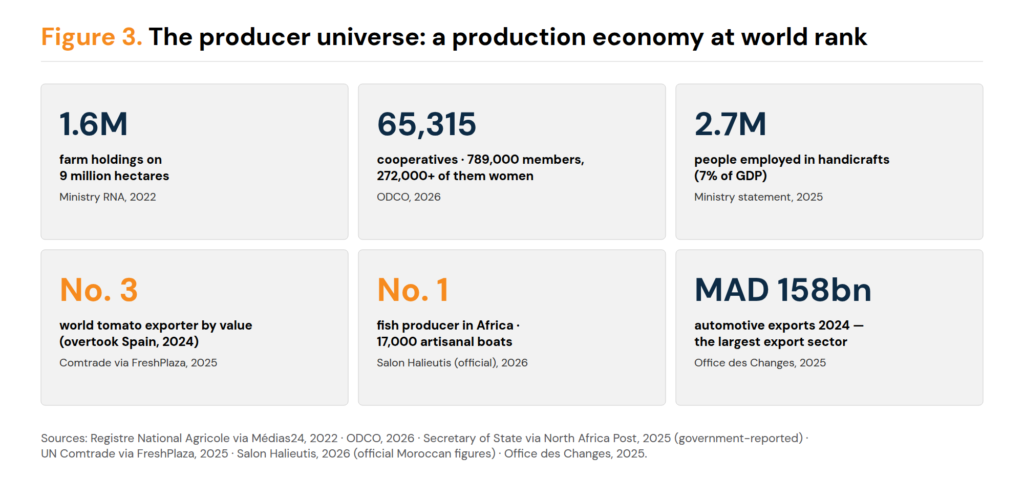
What no other market in this series offers is Morocco’s second population of potential digital earners: its producers. The scale is easy to underestimate. The national agricultural register covers 1.6 million farm holdings on nine million hectares (Ministry of Agriculture RNA via Médias24, 2022); agriculture still employs more than a quarter of the workforce (World Bank WDI, 2024). The cooperative economy counts 65,315 cooperatives with some 789,000 members — more than 272,000 of them women (ODCO, 2026). Handicrafts contribute 7 per cent of GDP and, on ministry figures, employ 2.7 million people — which the ministry describes as the country’s second-largest source of work (Secretary of State via North Africa Post, 2025). The fishing fleet includes 17,000 artisanal boats that land 92 per cent of a catch that, on official Moroccan figures, makes the country Africa’s largest fish producer (Salon Halieutis (official), 2026).
And these producers are not marginal players in world markets — they are, in several categories, at the top of them. Morocco became the world’s third-largest tomato exporter by value in 2024, overtaking Spain, with €1.57 billion in exports (Comtrade via FreshPlaza, 2025); it ranks fourth worldwide in berries, an industry-reported half-billion-dollar export built in a decade (Producer associations via Atalayar, 2025); it exported 540,000 tonnes of mandarins in the 2024/25 season (USDA FAS, 2025); Moroccan authorities describe the country as the world’s leading sardine exporter (Salon Halieutis, 2026). On the industrial side, automotive is the largest export sector at MAD 158 billion in 2024, aerospace employs 17,000 people exporting US$2.6 billion, and the country sits on roughly two-thirds of the world’s phosphate reserves — a USGS figure that includes Western Sahara (Office des Changes, 2025; US ITA, 2025; USGS, 2025). Morocco does not need to learn how to produce for the world. It already does.
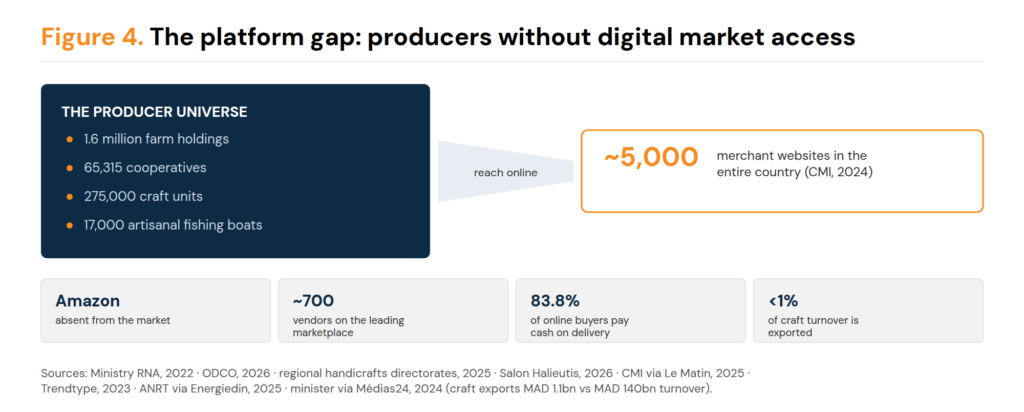
What Morocco’s producers lack is the platform layer — the digital shopfront, marketplace access, and payment rails that would let them display and trade under their own names, domestically and abroad. The gap is visible in one comparison: against 1.6 million farms, 65,315 cooperatives, and 275,000 craft units (regional handicrafts data via Yabiladi, 2025), Morocco’s interbank payment operator counts roughly 5,000 merchant websites in the entire country (CMI via Le Matin, 2025). Amazon has not entered the market; the leading domestic marketplace operates with roughly 700 vendors (Trendtype, 2023); and 83.8 per cent of online buyers still settle in cash on delivery (ANRT via Energiedin, 2025). The consequence lands hardest on the craft economy: a sector with MAD 140 billion in annual turnover exported a record MAD 1.1 billion in 2023 — less than one per cent of what it makes crosses a border (Minister via Médias24, 2024).
The cost of missing platforms is not abstract; it is measurable in who captures value. Argan — a UNESCO-inscribed heritage practice carried by rural women (UNESCO, 2014) — supplies a global cosmetic market estimated above US$700 million; yet as industrial intermediaries took over the export chain, the share of exports handled by the women’s cooperatives that harvest and press the oil collapsed from 80 per cent to 13 per cent between 2008 and 2013 — a share not documented to have recovered since (Equal Times/Investigate Europe, 2023). Producers without direct market access do not stop producing — they stop earning. Academic evidence confirms the pattern is general: a study of 102 cooperatives in the Agadir region found technical, economic, and external barriers jointly inhibiting e-commerce adoption (Bighrissen, Springer, 2023). The state has begun to respond — a “Morocco Handmade” online marketplace for small producers was announced in February 2026 (Morocco World News, 2026), and private B2B models such as Chari, which reports 15,000 digitised small merchants, show the mechanics work in Morocco (Arab Founders, 2025). What does not yet exist is the complete pathway: onboarding, credentialing, display, client access, payment, and verified income — for producers as much as for freelancers.
Payments: the layer where inclusion stalled
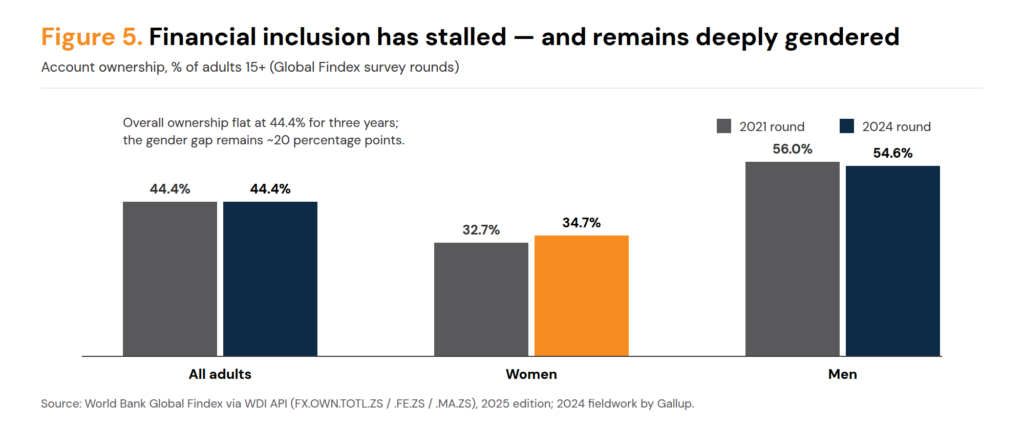
Every constraint above converges on payments. Account ownership in Morocco was 44.4 per cent of adults in 2024 — precisely where it stood in 2021: three years of digital-finance expansion with no measured gain in inclusion (Global Findex via WDI, 2025). The gender gap is roughly twenty points — 34.7 per cent of women against 54.6 per cent of men (Global Findex via WDI, 2025). Mobile wallets tell the sharper story: 13.7 million issued, but only 19.7 million transactions in all of 2024 — under one and a half transactions per wallet per year, two-thirds of them bill payments (Bank Al-Maghrib via Le360, 2025). Wallets have been distributed; they have not become how Moroccans are paid.
The reform arc is nonetheless real. Bank Al-Maghrib’s instant-payment rail, launched in 2023, processed more than 16 million transfers worth MAD 61.7 billion in 2024 (Bank Al-Maghrib via Morocco World News, 2025). For cross-border earnings — the freelancer’s and the exporting cooperative’s lifeline — the constraints are harder. PayPal balances long could not be withdrawn digitally in dirhams at all; in September 2025 the payment institution Cash Plus launched what it describes as the country’s only digital PayPal withdrawal service, aimed explicitly at freelancers and e-commerce sellers (Cash Plus/PayPal via Reuters, 2025) — company-reported, and telling: the friction was severe enough to warrant a dedicated national workaround. Beneath it all sits the exchange-control regime: the Office des Changes caps individuals’ international e-commerce spending at MAD 20,000 per year by instruction, with higher ceilings reserved for labelled technology firms (Office des Changes; ceilings under revision in 2026). Morocco’s payment problem is not an absence of rails — it is that the rails were not built with the individual earner, or the small producer, as their user.
The markets Morocco can serve
Morocco’s addressable demand is unusually broad for one country. Its workforce operates across French, Arabic, English, and Spanish — the language mix that built the offshoring sector’s client base of 1,200 international firms (Kearney/AMDIE via Atalayar, 2025). The Francophone market alone now counts 396 million speakers, two-thirds of them in Africa, on a trajectory toward well over half a billion by mid-century (OIF via Financial Afrik, 2026) — a demand pool for French-language digital services in which Morocco holds a natural cost and time-zone position, alongside the Arabic-language opportunity this series documented in the Jordan and Iraq analyses.
The nearest of those markets is Morocco’s own diaspora — millions strong and concentrated in Francophone Europe. Its remittances of MAD 117.7 billion a year, 7.8 per cent of GDP (Office des Changes via Médias24, 2025), prove two things at once: that cross-border income already flows into Moroccan households at national scale, and that the financial corridor exists. What diaspora households buy is precisely what resident Moroccans could sell digitally — national-curriculum education for their children, heritage goods from the regions their families came from, professional services in Arabic and French — if the transaction layer existed to carry it. Regional experience suggests such demand surfaces quickly once it does: in Jordan, the marketplace platform examined later in this analysis reports that the majority of its early transaction value has come from buyers outside the country, settled in Jordanian dinars through national payment rails with no international marketing — digitally exported national expertise, purchased largely by the region and the diaspora (company-reported, as of mid-2026). Digital livelihoods, in this frame, extend the diaspora relationship from sending wages home to buying services and products from home.
Why training alone — and promotion alone — will not close the gap
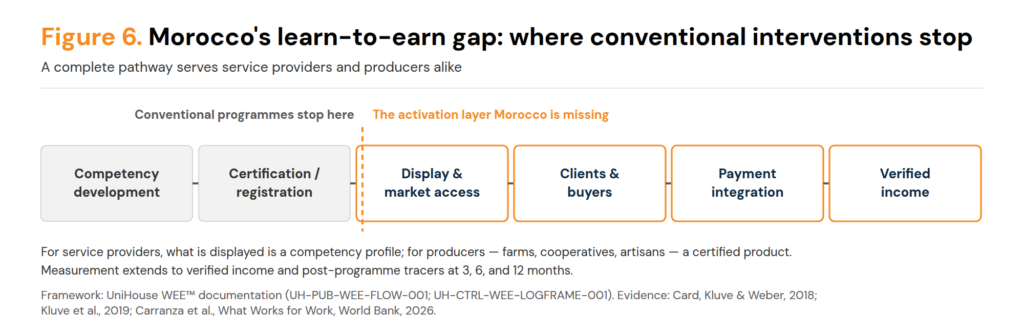
Morocco has not lacked programmes. Forsa reports more than 168,000 applications and some 10,000 supported project leaders; Awrach reports 103,599 participants; Intelaka reports 44,700 credits — all government-reported figures, with no independent impact evaluation yet located (Government figures via La Vie Éco). The global evaluation evidence explains why programme volume so rarely becomes income: standalone training produces employment effects close to zero in the short run, while programmes integrating multiple services — competency development, credentials, market access, payment, follow-up — are the ones that work, with top performers achieving gains three to five times the average (Card, Kluve & Weber, 2018; Kluve et al., 2019; Carranza et al., 2026). This series has set out that evidence in full in its activation framework analysis; the Moroccan corollary is direct. A training certificate does not open the individual pathway, and a cooperative workshop does not open the platform layer. Both require infrastructure.
The same supply-side critique applies, less noticed, to the product economy. Morocco’s export success is real but structurally concentrated: the chains that carry tomatoes to European supermarkets and vehicles to European ports are corporate and estate-run, and they do not carry the cooperative’s oil or the artisan’s brass. Support for small producers has largely mirrored the training model — episodic rather than infrastructural. Trade fairs, exhibitions, and buyer missions create moments of market access; they do not create standing channels through which a producer can be found, trusted, and paid on an ordinary Tuesday. Morocco’s own data show that channels, not products, are the binding constraint: when American demand found a route to Marrakech-Safi’s workshops, the region’s craft exports jumped 41 per cent in a single year, with shipments to the United States up 80 per cent (Regional Directorate via Consonews, 2025). A production economy at world rank does not need to be taught how to make. It needs somewhere permanent to sell — and the payment, verification, and logistics layers beneath it.
The infrastructure a complete pathway requires
What converts Morocco’s assets — a trilingual young population, world-rank producers, modernising payment rails — into livelihoods is the same architecture this series has examined throughout: structured mobilisation that reaches beyond the connected urban elite; market-aligned competency development; verifiable professional identity; access to clients and buyers; payment integration; and measurement that proves income rather than asserting it. Morocco adds a requirement no earlier market in this series has posed as sharply: the same pathway must serve two populations. The freelancer selling French-language services to Lyon and the argan cooperative selling oil to Berlin need the same six layers — differing only in what is displayed: a competency profile in one case, a certified product in the other. An activation framework that carries both, disaggregating every indicator by gender from the baseline, is what the evidence — and the framework reference this series draws on — describes.
The reference implementation: Jordan
The working regional reference is Jordan, where Ostathi operates with the Ministry of Digital Economy and Entrepreneurship under the World Bank-financed Youth, Technology and Jobs programme — the deployment examined in this series’ Jordan analysis. Its most transferable element for Morocco is the measurement spine. The Ostathi Digital Ledger operates as an integration layer across regulated national payment providers — in Jordan, MEPS Jordan and HyperPay — holding client payments in escrow until delivery is confirmed and recording every transaction as a timestamped, auditable income event. Income is never self-reported; it is generated, recorded, and verified inside the system. When this measurement design was documented in 2026, the announcement syndicated via Reuters and AP News and carried by Yahoo Finance centred on the measurement architecture itself. For Morocco, the design principle is platform-agnostic delivery: the stages and the measurement stay constant, while payment integration would be rebuilt on Morocco’s own rails — the instant-payment system, the wallet network, and the export-settlement channels its producers already use for goods.
From analysis to implementation
The country-platform model examined in this series was designed for adaptation: occupational tracks, languages, partner institutions, and payment integration follow each country’s reality while the architecture holds constant. A Moroccan deployment is not announced; this analysis is, in effect, its design brief — occupational selection spanning digitally delivered services and product trade, delivery in Arabic and French, payment onboarding built on Moroccan rails within the exchange-control framework, and measurement disaggregated by gender and region from the first cohort. Consistent with the standard applied throughout this series, any future results would be reported as verified figures with dates, not projections.
Implications for government and development partners
For the government, the evidence suggests the digital-jobs agenda and the producer agenda are one agenda. Digital Morocco 2030’s 240,000-job target and Génération Green’s ambition of an agricultural middle class of 350,000 to 400,000 households (US ITA, 2025) converge on the same missing layer: platforms through which individuals and small producers can sell, be paid, and prove income. Procurement that specifies complete pathways — with named verification at every stage, per the results-chain discipline set out in this series’ framework analysis — will buy more than procurement that specifies training volumes; the two-pathway asymmetry documented above suggests the highest-return reform is extending to individuals the seriousness the state already shows to offshoring firms.
For development partners, Morocco offers what few markets do: production at verified world rank, a demonstrated services-export sector, and a measurable platform gap in between. The World Bank’s own 2026 jobs diagnostic identifies four priority sectors without naming digital services (World Bank, 2026) — a gap this analysis suggests deserves interrogation, given the government’s own targets and the evidence on digital adoption and productivity. Programmes that connect women’s cooperatives to direct digital markets address, in one design, the participation gap, the value-capture problem, and the inclusion gap that Findex documents.
There is also a precise instrument fit. Bilateral and multilateral partners are long established in Morocco — GIZ has operated in the country since 1975, with job creation and women’s employment among its stated priorities (GIZ Morocco), alongside the EU’s programmes and the Millennium Challenge Corporation’s education-to-employability compact (MCA-Morocco). A growing class of their instruments funds private-sector scaling rather than programme delivery: technical assistance that helps proven operators cross the fixed costs of entering a market lawfully — local establishment, payment integration, data-protection compliance, demand generation. The platform layer this analysis identifies is a natural object for exactly that instrument class, and a better-evidenced one than another training cohort: an instrumented pathway produces, at every stage, the auditable outcome data that results-based cooperation requires — the argument set out in this series’ framework analysis.
Conclusion
Morocco enters the digital livelihoods era from a position no other market in this series occupies: it already produces for the world, already exports digital services at industrial scale, and already connects nearly everyone. What it has not built is the layer that lets individuals and small producers do what its corporations and estates do — display, sell, be paid, and prove it. The evidence assembled here suggests that is not a marketing problem or a training problem; it is missing infrastructure, with a known architecture and a working regional reference. A third of Morocco’s young people are waiting on it, a third of a million cooperatives and craft units are producing beneath it, and the demographic window in which it matters most is measurably closing. On the evidence, the platform layer is Morocco’s shortest bridge between the growth it has and the participation it lacks.
Frequently asked questions
What are digital livelihoods, and why do they matter for Morocco?
A digital livelihood is an income stream generated through digitally delivered work or digitally mediated trade — services sold to clients anywhere, or products displayed and sold through digital channels. Morocco matters as a case because it needs both: a young, trilingual, connected population facing 37.2 per cent youth unemployment on the national series, and a world-rank production economy — farms, cooperatives, artisans, fisheries — that trades almost entirely offline.
Why is youth unemployment so high when Morocco’s economy is growing?
Because growth and employment have decoupled: the World Bank finds Morocco’s working-age population grew two and a half times faster than employment between 2000 and 2024. Record growth in 2025 — 4.9 per cent — coexisted with rising youth unemployment because the sectors driving growth create relatively few jobs, while agriculture, the largest traditional employer, is shedding them.
Can Moroccan farmers, cooperatives, and artisans sell online today?
Mostly not at any scale. Against 1.6 million farms, more than 65,000 cooperatives, and 275,000 craft units, Morocco counts roughly 5,000 merchant websites; Amazon is absent, the leading domestic marketplace lists some 700 vendors, and 83.8 per cent of online purchases settle in cash on delivery. The result: a craft sector with MAD 140 billion in turnover exports less than one per cent of it. Government initiatives such as the announced Morocco Handmade marketplace recognise the gap; the complete pathway — display, buyers, payment, verified income — is what remains to be built.
What is the biggest barrier between digital skills and digital income in Morocco?
Payments and market access, not connectivity. Account ownership has been flat at 44.4 per cent of adults since 2021, with a twenty-point gender gap; mobile wallets average under one and a half transactions a year; cross-border withdrawals long required workarounds; and exchange-control ceilings cap individuals’ international e-commerce by instruction. Morocco’s rails are modernising quickly — but they were not designed around the individual earner or the small producer.
Is Ostathi operating in Morocco today?
Not yet. Ostathi currently operates in Jordan, where it is deployed with the Ministry of Digital Economy and Entrepreneurship under the World Bank-financed Youth, Technology and Jobs programme. This series analyses markets on their evidence, ahead of any deployment decision; a Moroccan deployment would be designed around Morocco’s own labour market, languages, payment rails, and producer economy.
References
Afrobarometer (2025). Youth like Morocco’s direction even as jobs remain scarce and interest in emigration grows. Dispatch AD1004, 23 June 2025. https://www.afrobarometer.org/publication/ad1004-youth-like-moroccos-direction-even-as-jobs-remain-scarce-and-interest-in-emigration-grows/ Accessed 27 August 2026.
Arab Founders (2025). Chari raises $12M Series A. Company-reported figures. https://arabfounders.net/en/chari-raises-12m-series-a-morocco-fintech/ Accessed 27 August 2026.
Atalayar (2025). Competitive costs and multilingual workforce: Morocco’s keys to becoming a global outsourcing hub. AMDIE/Kearney figures, December 2025. https://www.atalayar.com/en/articulo/economy-and-business/competitive-costs-and-multilingual-workforce-moroccos-keys-to-becoming-global-outsourcing-hub/20251223162347221712.html Accessed 27 August 2026.
Atalayar (2025). Morocco ranks 4th worldwide in the export of berries. Producer-association figures, September 2025. https://www.atalayar.com/en/articulo/economy-and-business/morocco-ranks-4th-worldwide-in-the-export-of-berries/20250912151606218086.html Accessed 27 August 2026.
Bank Al-Maghrib data via Le360 (2025). Le paiement mobile s’impose enfin au Maroc: 32% de croissance en un an. (French.) https://fr.le360.ma/economie/le-paiement-mobile-simpose-enfin-au-maroc-32-de-croissance-en-un-an_4CSBI3ZFINFALEHBJO3YDDCC5M/ Accessed 27 August 2026.
Bank Al-Maghrib data via Morocco World News (2025). BAM: Morocco records rapid growth in digital payments in 2024. November 2025. https://www.moroccoworldnews.com/2025/11/269538/bam-morocco-records-rapid-growth-in-digital-payments-in-2024/ Accessed 27 August 2026.
Bighrissen, B. (2023). Towards understanding e-commerce adoption among cooperatives in Morocco. In: International Conference on Digital Technologies and Applications, Springer LNNS. https://link.springer.com/chapter/10.1007/978-3-031-08093-7_37 Accessed 27 August 2026.
Card, D., Kluve, J. and Weber, A. (2018). What Works? A Meta-Analysis of Recent Active Labor Market Program Evaluations. JEEA 16(3) / NBER WP 21431. https://www.nber.org/papers/w21431 Accessed 27 August 2026.
Carranza, E. et al. (2026). What Works for Work: A Guidebook to Proven and Promising Employment Solutions. World Bank. https://documents1.worldbank.org/curated/en/099012126020061187/pdf/P506693-6fa65cb1-1bb8-4afa-9ef0-66f72970af23.pdf Accessed 27 August 2026.
Cash Plus / PayPal press release via Reuters (2025). Cash Plus partners with PayPal to simplify withdrawals for Morocco’s digital generation. 16 September 2025. Company-reported. https://de.tradingview.com/news/reuters.com%2C2025-09-16%3Anewsml_ZawcdzPHD%3A0-pressr-cashplus-partners-with-paypal-to-simplify-withdrawals-and-global-shopping-for-morocco-s-digital-generation Accessed 27 August 2026.
CGEM (2024). Official launch of the national strategy Morocco Digital 2030. September 2024. https://cgem.ma/en/actualites/official-launch-of-the-national-strategy-morocco-digital-2030/ Accessed 27 August 2026.
CMI figures via Le Matin (2025). Le CMI vise 700 MMDH de paiements électroniques à l’horizon 2030. (French.) https://lematin.ma/economie/le-cmi-vise-700-mmdh-de-paiements-electroniques-a-lhorizon-2030/302580 Accessed 27 August 2026.
DataReportal / Kepios (2026). Digital 2026: Morocco. https://datareportal.com/reports/digital-2026-morocco Accessed 27 August 2026.
Equal Times (2023). Faced with competition from big business, Morocco’s argan oil cooperatives fight to survive. Citing ANDZOA and academic research. https://www.equaltimes.org/faced-with-competition-from-big Accessed 27 August 2026.
GIZ. Morocco — country page: sectors, priorities, and presence since 1975. Accessed August 2026. https://www.giz.de/en/regions/africa/morocco Accessed 27 August 2026.
Government programme figures via La Vie Éco. Awrach, Forsa et Intelaka ont donné des résultats tangibles. Government-reported. (French.) https://www.lavieeco.com/affaires/awrach-forsa-et-intelaka-ont-donne-des-resultats-tangibles-2/ Accessed 27 August 2026.
Millennium Challenge Account–Morocco. Education and Training for Employability project (US$220 million compact component). https://www.mcamorocco.ma/en/project/education-and-training-employability Accessed 27 August 2026.
Regional Directorate of Handicrafts, Marrakech-Safi, via Consonews (2025). Marrakech handicraft exports reach MAD 458.5 million in 2024, +41%. (French.) https://consonews.ma/57280.html Accessed 27 August 2026.
HCP — Haut-Commissariat au Plan (2025). Activité, emploi et chômage: résultats annuels 2024. (French.) https://www.hcp.ma/Activite-emploi-et-chomage-resultats-annuels-2024_a4142.html Accessed 27 August 2026.
HCP (2026). Situation du marché du travail en 2025. (French.) https://www.hcp.ma/Situation-du-marche-du-travail-en-2025_a4248.html Accessed 27 August 2026.
HCP (2024). Population légale du Royaume du Maroc — RGPH 2024. (French.) https://www.hcp.ma/Population-legale-du-Royaume-du-Maroc-repartie-par-regions-provinces-et-prefectures-et-communes-selon-les-resultats-du_a3974.html Accessed 27 August 2026.
HCP projections via Morocco World News (2026). Morocco’s population to reach 43.3 million by 2060 as aging accelerates. July 2026. https://www.moroccoworldnews.com/2026/07/328042/hcp-moroccos-population-to-reach-43-3-million-by-2060-as-aging-accelerates/ Accessed 27 August 2026.
HCP–ILO–EU joint assessment (2023 data) via Morocco World News (2026). One in three young Moroccans are NEET. April 2026. https://www.moroccoworldnews.com/2026/04/288511/one-in-three-young-moroccans-are-neet-as-2-9-million-face-job-education-gaps/ Accessed 27 August 2026.
Hortoinfo/Comtrade via FreshPlaza (2025). Morocco surpassed Spain in tomato export value in 2024. May 2025. https://www.freshplaza.com/europe/article/9729909/morocco-surpassed-spain-in-tomato-export-value-in-2024/ Accessed 27 August 2026.
Kluve, J. et al. (2019). Do youth employment programs improve labor market outcomes? A quantitative review. World Development 114. https://ideas.repec.org/a/eee/wdevel/v114y2019icp237-253.html Accessed 27 August 2026.
Médias24 (2022). Ce qu’il faut savoir sur le Registre National Agricole. (French.) https://medias24.com/2022/05/27/objectifs-fonctionnement-ce-quil-faut-savoir-sur-le-registre-national-agricole/ Accessed 27 August 2026.
Médias24 (2024). Les exportations d’artisanat ont atteint 1,1 milliard de dirhams en 2023, un nouveau record. Minister’s figures. (French.) https://medias24.com/2024/03/28/f-z-ammor-les-exportations-dartisanat-ont-atteint-11-milliard-de-dirhams-en-2023-un-nouveau-record/ Accessed 27 August 2026.
Médias24 (2025). Les transferts des MRE atteignent 117,7 MMDH à fin 2024. Office des Changes data. (French.) https://medias24.com/2025/02/06/les-transferts-des-mre-atteignent-1177-mmdh-a-fin-2024-generant-77-du-pib/ Accessed 27 August 2026.
Ministry statement via TelQuel (2024). Près de 400 000 auto-entrepreneurs actifs au Maroc. November 2024. (French.) https://telquel.ma/instant-t/2024/11/19/pres-de-400-000-auto-entrepreneurs-actifs-au-maroc-selon-younes-sekkouri_1905007/ Accessed 27 August 2026.
Morocco World News (2025). Morocco unveils new offshoring incentive framework to boost digital economy. November 2025. https://www.moroccoworldnews.com/2025/11/269306/morocco-unveils-new-offshoring-incentive-framework-to-boost-digital-economy/ Accessed 27 August 2026.
Morocco World News (2026). Morocco to develop ‘Morocco Handmade’ online marketplace among other new handicrafts sector initiatives. February 2026. https://www.moroccoworldnews.com/2026/02/278077/morocco-to-develop-morocco-handmade-online-marketplace-among-other-new-handicrafts-sector-initiatives/ Accessed 27 August 2026.
North Africa Post (2025). Morocco’s handicrafts sector amounts to 7% of GDP. Secretary of State’s figures, June 2025. https://northafricapost.com/88234-moroccos-handicrafts-sector-amounts-to-7-of-gdp.html Accessed 27 August 2026.
ODCO — Office du Développement de la Coopération (2026). Morocco closes the International Year of Cooperatives in Rabat. https://www.odco.gov.ma/morocco-closes-the-international-year-of-cooperatives-in-rabat/?lang=en Accessed 27 August 2026.
Office des Changes (2025). Indicateurs mensuels des échanges extérieurs, année 2024. Official PDF. (French.) https://casainvest.ma/sites/default/files/2025-02/Echanges%20ext%C3%A9rieurs%202024.pdf Accessed 27 August 2026.
Office des Changes. Commerce électronique à l’international — Instruction Générale des Opérations de Change. (French.) https://www.oc.gov.ma/fr/commerce-electronique-a-international Accessed 27 August 2026.
Salon Halieutis (2026). Le secteur halieutique au Maroc. Official sector figures. https://salonhalieutis.com/en/secteur-halieutique Accessed 27 August 2026.
ANRT/e-commerce indicators via Energiedin (2025). E-commerce au Maroc: chiffres clés. Citing Bank Al-Maghrib and ANRT series. (French.) https://www.energiedin.com/blog/e-commerce-maroc/ Accessed 27 August 2026.
ANRT via Le Matin (2025). Maroc: 39,9 millions d’abonnements internet à fin mars 2025. (French.) https://lematin.ma/economie/maroc-399-millions-dabonnements-internet-a-fin-mars-2025/285362 Accessed 27 August 2026.
Trendtype (2023). Morocco’s Marjane Mall is looking to hit $97m GMV in 2025. https://trendtype.com/news/moroccos-marjane-mall-is-looking-to-hit-97m-gmv-in-2025/ Accessed 27 August 2026.
UNESCO (2014). Argan, practices and know-how concerning the argan tree. Representative List of the Intangible Cultural Heritage of Humanity. https://ich.unesco.org/en/RL/argan-practices-and-know-how-concerning-the-argan-tree-00955 Accessed 27 August 2026.
US International Trade Administration (2025). Morocco — Aerospace. Country Commercial Guide. https://www.trade.gov/country-commercial-guides/morocco-aerospace Accessed 27 August 2026.
OIF via Financial Afrik (2026). Africa, driving force of the French language — 6th OIF Observatory report. March 2026. https://www.financialafrik.com/en/2026/03/18/africa-driving-force-of-the-french-language-oif-report/ Accessed 27 August 2026.
Regional Directorate of Handicrafts, Fès, via Yabiladi (2025). Morocco’s handicraft sector: billion-dirham figures. February 2025. https://en.yabiladi.com/articles/details/159544/morocco-s-handicraft-sector-billion-dirham.html Accessed 27 August 2026.
Ostathi. WEE™ Framework — the learn-to-earn engine by UniHouse. Framework reference page. https://ostathi.com/wee-framework/ Accessed 27 August 2026.
Reuters (2026). Ostathi, operated by UniHouse, pioneers digital infrastructure linking workforce development to verified income. Press-release syndication, 7 May 2026. https://www.reuters.com/press-releases/ostathi-unihouse-digital-infrastructure-linked-workforce-development-income-2026-05-07/ Accessed 27 August 2026.
AP News (2026). Ostathi pioneers the Middle East’s first digital infrastructure linking structured workforce development to verified income. Press-release syndication, May 2026. https://apnews.com/press-release/access-newswire/ostathi-operated-by-unihouse-pioneers-the-middle-easts-first-digital-infrastructure-linking-structured-workforce-development-to-verified-income-ed072360ac5a278d7aa2802fc9be4cf8 Accessed 27 August 2026.
Yahoo Finance (2026). Ostathi, operated by UniHouse, pioneers Middle East digital infrastructure for verified income. May 2026. https://uk.finance.yahoo.com/news/ostathi-operated-unihouse-pioneers-middle-163000890.html Accessed 27 August 2026.
US International Trade Administration (2025). Morocco — Agricultural Sector. Country Commercial Guide (Génération Green targets). https://www.trade.gov/country-commercial-guides/morocco-agricultural-sector Accessed 27 August 2026.
USDA Foreign Agricultural Service (2025). Citrus Annual — Rabat, Morocco (MO2025-0021). GAIN report. https://apps.fas.usda.gov/newgainapi/api/Report/DownloadReportByFileName?fileName=Citrus+Annual_Rabat_Morocco_MO2025-0021.pdf Accessed 27 August 2026.
USGS (2025). Mineral Commodity Summaries 2025 — Phosphate Rock. https://pubs.usgs.gov/periodicals/mcs2025/mcs2025-phosphate.pdf Accessed 27 August 2026.
World Bank (2023). Informal employment in Egypt, Morocco and Tunisia: what can we learn to boost inclusive growth? Arab Voices blog. https://blogs.worldbank.org/en/arabvoices/informal-employment-egypt-morocco-tunisia-what-can-we-learn-boost-inclusive-growth Accessed 27 August 2026.
World Bank (2026). Morocco can accelerate growth, attract private investment and generate millions of jobs. Growth and Jobs Report / CPSD press release, 28 April 2026. https://www.worldbank.org/en/news/press-release/2026/04/28/morocco-can-accelerate-growth-attract-private-investment-and-generate-millions-of-jobs-through-structural-and-other-poli Accessed 27 August 2026.
World Bank (2026). Public investment powers Morocco’s strongest growth in a decade. Morocco Economic Update, Summer 2026, 23 July 2026. https://www.worldbank.org/en/news/press-release/2026/07/23/public-investment-powers-morocco-s-strongest-growth-in-a-decade Accessed 27 August 2026.
World Bank Global Findex via WDI API (2025). Account ownership, total / female / male (FX.OWN.TOTL.ZS; .FE; .MA), Morocco. https://api.worldbank.org/v2/country/MAR/indicator/FX.OWN.TOTL.ZS?format=json&mrv=4 Accessed 27 August 2026.
World Bank WDI API (2025). Youth unemployment, ILO modelled (SL.UEM.1524.ZS); female labour force participation (SL.TLF.CACT.FE.ZS); agriculture employment (SL.AGR.EMPL.ZS), Morocco. https://api.worldbank.org/v2/country/MAR/indicator/SL.UEM.1524.ZS?format=json&mrv=5 Accessed 27 August 2026.
Ostathi (2026). Digital Livelihoods in Jordan. jo.ostathi.com. https://jo.ostathi.com/digital-livelihoods-jordan Accessed 27 August 2026.
Ostathi (2026). Digital Livelihoods in Iraq: The Next Learn-to-Earn Market. https://ostathi.com/digital-livelihoods-iraq/ Accessed 27 August 2026.
Ostathi (2026). From Training to Income: Why Workforce Programmes Need an Activation Framework. https://ostathi.com/workforce-activation-framework/ Accessed 27 August 2026.
Methodology note
This analysis synthesises official Moroccan statistics (HCP, Office des Changes, ODCO, ANRT via press reporting of official series), international institutional sources (World Bank, ILO-modelled series, USDA, USGS, UNESCO, OIF, Afrobarometer), peer-reviewed research, and attributed industry and government-reported figures. All sources were verified as accessible as of 27 August 2026. Morocco publishes two youth-unemployment series — the HCP national labour force survey and the ILO harmonised estimate — which differ methodologically; this analysis labels each on every use and never combines them. Figures reported by government agencies, ministries, AMDIE, and companies are attributed as such and have not been independently verified; programme results for Forsa, Awrach, and Intelaka are government-reported with no independent evaluation located. The exchange-control ceiling cited reflects the Office des Changes instruction in force at the time of writing; ceilings announced for revision in 2026 should be confirmed against the current instruction. This article is an analytical publication of the Ostathi Insights series and does not constitute an evaluation of any specific programme, nor an announcement of operations in Morocco.
August 29, 2026, 12:54 pm
[…] series’ geography has since extended westward: the Morocco analysis examines a producing economy with the opposite starting point — world-rank exports, but no […]