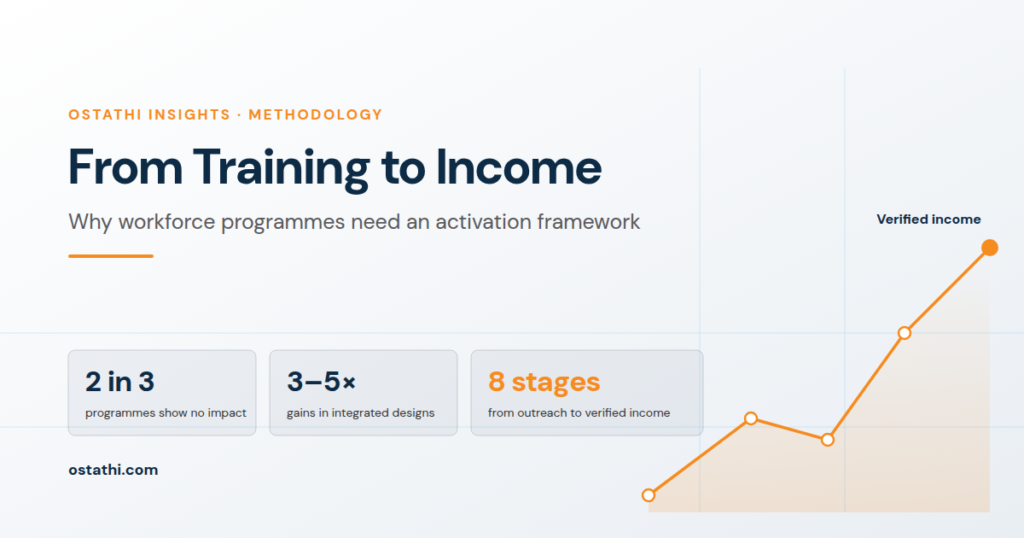
Most workforce programmes measure what they deliver — enrolments, courses, certificates — rather than what participants go on to earn. Decades of evaluation evidence suggest that this distinction, more than any curriculum choice, decides whether programmes change lives. This analysis examines what that evidence says, and what a complete activation framework looks like.
The two-thirds problem
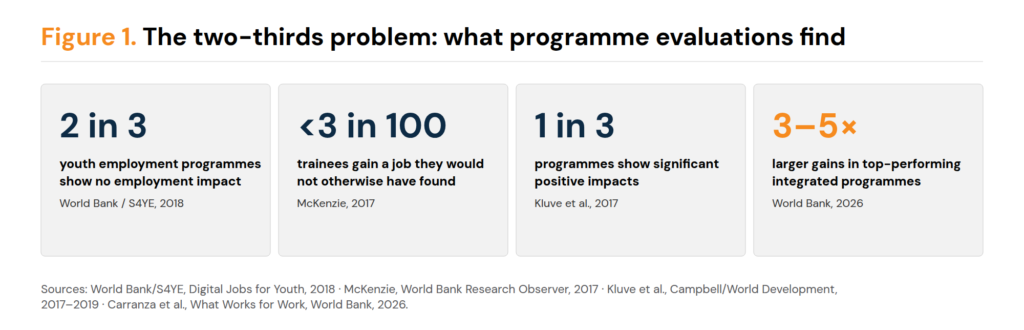
The most uncomfortable finding in the youth employment literature comes from the World Bank’s own Solutions for Youth Employment coalition: “almost two-thirds of youth employment programs fail to have any impact on youth employment” — a failure the coalition attributes to programmes that concentrate on the supply side of the labour market while leaving demand, market access, and follow-through unaddressed (World Bank/S4YE, 2018). The World Bank’s own evaluators put the complement just as plainly: “one out of three youth employment programs had positive and statistically significant impacts on labor market outcomes” (Kluve & Puerto, 2017).
The problem is not a shortage of programmes, and it is not a shortage of jobs data pointing at the need. Global youth unemployment stood at 13.0 per cent in 2023 — 64.9 million young people, and a fifteen-year low — yet one in five young people worldwide was not in employment, education, or training, and two-thirds of those were young women (ILO, 2024). More than half of young workers hold informal jobs. The quantity of employment has recovered from the pandemic years; the pathway from learning into decent, measurable income has not. Governments and development partners continue to finance workforce programmes at scale — and, on the evidence, most of that finance purchases activity rather than outcomes.
What the evaluation evidence actually says
The evidence base on active labour market programmes is now deep enough to be read as a single arc, and it moves in three steps: training alone does little; integrated, sequenced programmes work; and the effects of complete pathways compound rather than fade.
Training alone moves almost nothing in the short run
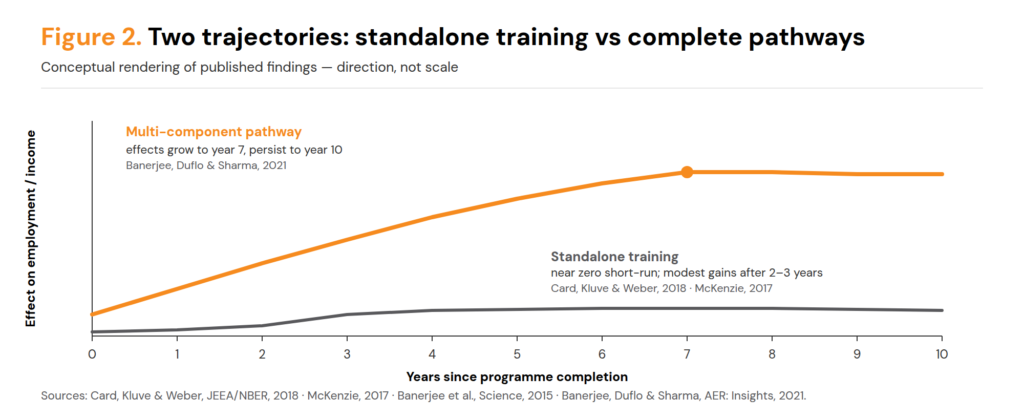
The canonical meta-analysis of active labour market programme evaluations found that average impacts are “close to zero in the short run,” improving only two to three years after completion, with human-capital-intensive designs faring better over time (Card, Kluve & Weber, 2018). For developing countries the at-scale arithmetic is starker. Reviewing the experimental literature, the World Bank’s David McKenzie concluded that for every 100 people offered vocational training, fewer than three find a job they would not otherwise have found — an average employment gain of about 2.3 percentage points, at a cost of roughly US$17,000 to US$60,000 per additional person employed. On those numbers, he noted, it is hard to find a standalone training programme that passes a simple cost-benefit test (McKenzie, 2017).
Design beats content: integrated programmes outperform
The largest systematic review of youth employment interventions — 3,105 effect estimates from more than 100 programme evaluations — reached a conclusion that reframes the entire design question: the type of intervention matters less than how it is designed and delivered, and “programs integrating multiple services are more successful.” Programmes that profile their participants, follow up individually, and hold service providers accountable outperform those that simply deliver content; and impacts grow in the long term (Kluve et al., 2019; review summary: Campbell Collaboration). The World Bank’s own stocktake of integrated youth employment programmes is explicit on the same point: “combinations of programs are overall more effective,” because solving one constraint is not sufficient when participants face several at once. In Kenya, combining classroom instruction with workplace experience raised employment by 15 per cent and earnings by 26 per cent (World Bank Jobs WP 24, 2019).
The most recent synthesis carries the argument into operational guidance. Reviewing more than 100 evaluated employment programmes for the 2026 Global Labor Market Conference, the World Bank found that top-performing programmes achieve gains three to five times larger than the average — and that what separates them is design that addresses “multiple, reinforcing constraints to employment” in an integrated way, built in partnership with the private sector rather than around it (Carranza et al., 2026).
Complete pathways compound; partial interventions fade
The strongest causal evidence for sequenced, multi-component design comes from the six-country graduation randomised controlled trials published in Science: a structured sequence — productive asset, consumption support, training, coaching, savings — evaluated across 21,000 people in Ethiopia, Ghana, Honduras, India, Pakistan, and Peru, produced statistically significant, cost-effective gains in consumption and psychosocial wellbeing, with positive returns in five of six countries ranging from 133 per cent to 433 per cent (Banerjee et al., 2015; programme evidence: IPA). Follow-up work published in AER: Insights found the effects still present a decade later — growing for the first seven years after the intervention before stabilising (Banerjee, Duflo & Sharma, 2021). Complete pathways do not merely outperform partial interventions at endline; they diverge from them for years afterwards.
Why single interventions fail: the multiple-constraints logic
The mechanism behind these findings is not mysterious. A young person out of work does not face one barrier; she faces a stack of them. She may lack competencies the market will pay for — but also proof of those competencies a client can trust, access to clients in the first place, a way to price and present a service, a channel through which payment can legally and reliably arrive, and support through the discouraging early months in which most attempts fail. These constraints reinforce one another: remove any one and the others still bind. A certificate without client access earns nothing; client access without a payment channel converts demand into frustration rather than income. This is what the World Bank means by “multiple, reinforcing constraints to employment” (Carranza et al., 2026), and it is why S4YE insists that programmes address supply and demand “in an integrated way” (World Bank/S4YE, 2018).
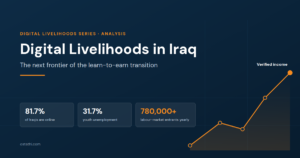
The digital economy raises the stakes of this logic rather than escaping it. Online gig work now accounts for up to 12 per cent of the global labour market, mediated by 545 platforms operating across 186 countries, with demand growing fastest in developing regions (World Bank, 2023). The opportunity is real, but every constraint in the stack remains: this series has documented the pattern at country level in Jordan, where connectivity and education have long coexisted with under-employment, and where pathway infrastructure is now being built, and in Iraq, where near-complete connectivity coexists with one of the region’s widest gaps between learning and income — bound, above all, by the payment layer. Connectivity, in both analyses, is necessary and radically insufficient.
The anatomy of an activation framework
If the evidence points to integrated, sequenced, measured pathways, the operational question becomes: what must a programme design actually contain to qualify? The development community has had the underlying grammar for decades. The OECD’s Development Assistance Committee defines the results chain as “the causal sequence for a development intervention that stipulates the necessary sequence to achieve desired objectives beginning with inputs, moving through activities and outputs, and culminating in outcomes, impacts, and feedback” (OECD DAC, 2002/2023); the UN system’s results-based management handbook builds the same logic into standard programme design (UNDG, 2011). What has been missing is not the grammar but its application to workforce programmes end-to-end: most programmes apply results discipline to the parts they control — enrolment, delivery, completion — and stop measuring precisely where the results chain becomes hard, at income.
An activation framework, as this analysis uses the term, is a programme architecture with six properties. First, an explicit results chain from outreach to sustained income — not from enrolment to certification. Second, defined stages with entry and exit criteria, so that progression is earned and visible rather than assumed. Third, indicators specified per stage, with disaggregation by gender and location built in from the baseline rather than reconstructed afterwards. Fourth, a named means of verification for every indicator — the specific record, system, or dataset that substantiates the claim. Fifth, stated assumptions at every stage, so that the design declares the conditions under which it can fail. Sixth, measurement that continues after the programme ends, because the evidence above shows that the effects that matter are the ones that persist. A curriculum is not a framework; neither is a platform. A framework is the connective tissue that makes courses, tools, and marketplaces add up to a pathway.
A worked example: the Workforce & Entrepreneurship Engine (WEE™)
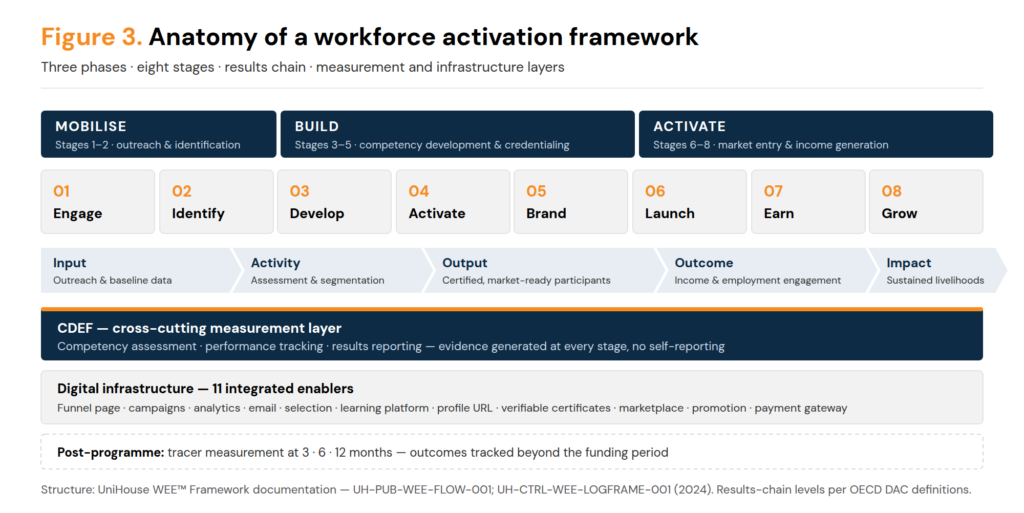
The Workforce & Entrepreneurship Engine (WEE™), developed by UniHouse and delivered through the Ostathi digital marketplace, is one documented attempt to build a framework with all six properties. It is examined here as a worked example of the anatomy above — the structure the evidence calls for, rendered as an operating model. WEE organises the pathway into three phases and eight stages. The Mobilise phase covers targeted outreach and enrolment (Engage) and structured intake assessment, segmentation, and baseline data collection (Identify). The Build phase covers market-aligned competency development governed by defined assessment thresholds (Develop), service definition, pricing, and entrepreneurial readiness (Activate), and verifiable certification with activation of a professional digital profile (Brand). The Activate phase covers marketplace go-live and initial client engagement (Launch), income generation supported by mentorship and internships (Earn), and scaling toward sustainable livelihoods with measurement systems handed over for continued tracking (Grow).
Two design decisions distinguish the architecture. The first is that measurement is a layer, not a report: the Capacity Development Evaluation Framework (CDEF) operates across all eight stages as a cross-cutting system for competency assessment, performance tracking, and results reporting, so that every stage generates evidence as a by-product of operating. The second is that the pathway is digitally instrumented end to end — eleven integrated components, from outreach funnel and analytics dashboard through the online learning platform to marketplace profiles, certificates, and payment gateway — which is what makes the measurement layer possible at all. Each stage maps onto the results chain: mobilisation stages generate inputs and activities, competency development and credentialing stages generate outputs, and marketplace stages generate the outcomes — income generation and employment engagement — that the whole design exists to produce.
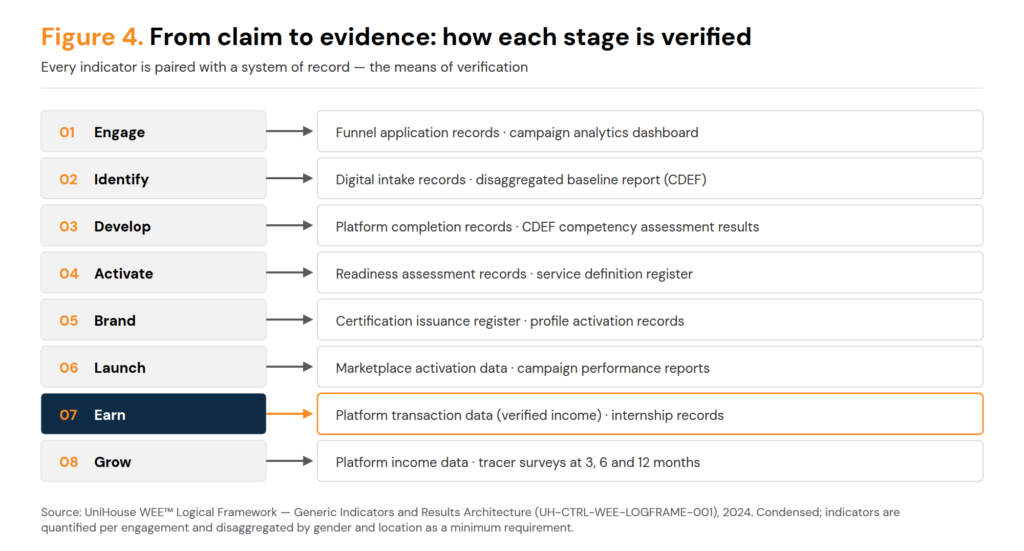
The framework’s logical framework specifies, for every stage, a result statement, indicators to be quantified per engagement, means of verification, and assumptions — with all indicators disaggregated by gender, location, and participant status as a minimum requirement (UH-CTRL-WEE-LOGFRAME-001). The table below shows the progression discipline in condensed form.
Table 1. The WEE™ eight-stage pathway mapped to results-chain levels and verification sources. Condensed from UniHouse WEE™ Logical Framework (UH-CTRL-WEE-LOGFRAME-001, 2024); vocabulary aligned with UniHouse terminology standards.
| Stage | Results-chain level | Result (condensed) | Verified through |
| 01 Engage | Input | Eligible participants mobilised and enrolled through targeted digital outreach | Funnel application records; campaign analytics |
| 02 Identify | Activity | Structured intake, segmentation, and disaggregated baseline data | Digital intake records; baseline data report (CDEF) |
| 03 Develop | Output | Market-aligned competency development completed to defined CDEF thresholds | Platform completion records; CDEF assessment results |
| 04 Activate | Output | Service offerings, pricing, and entrepreneurial readiness defined | Readiness assessment records; service register |
| 05 Brand | Output | Verifiable certification issued; professional marketplace profile activated | Certification register; profile activation records |
| 06 Launch | Outcome | Active marketplace participation with initial client engagement | Platform activation data; campaign performance reports |
| 07 Earn | Outcome | Income generated through digital work and employment, supported by mentorship and internships | Platform transaction data (verified income); internship records |
| 08 Grow | Outcome → Impact | Income growth, repeat clients, formalisation; measurement handed over | Platform income data; tracer surveys at 3, 6, and 12 months |
The measurement layer: from attendance to verified income
Most workforce programmes can prove attendance. Far fewer can prove income — and when they claim to, the claim usually rests on self-reported survey responses collected months after the fact. The methodological literature is clear about the cost of that shortcut: administrative and system-generated records are more accurate than surveys for exactly the outcomes that matter here — income and employment — and passively captured data avoids the social-desirability and recall biases that inflate self-reports (J-PAL). In the Oregon Health Insurance Experiment, administrative records detected significant effects on emergency-department use that participant self-reports missed — a warning for any programme whose outcome claims rest on asking participants how they are doing.
This is the problem the measurement layer of an activation framework exists to solve, and it is where the digital instrumentation becomes decisive rather than decorative. In the WEE architecture, no outcome indicator relies on self-reporting: competency is assessed against CDEF thresholds on the learning platform; certification and profile activation are system events; client engagement is platform data; and income is recorded at the moment it occurs. The deepest element of this design, per the framework’s published documentation, is the Ostathi Digital Ledger, which operates as an integration layer across regulated national payment providers — in Jordan, MEPS Jordan and HyperPay — holding client payments in escrow until service delivery is confirmed, settling earnings from clients inside or outside the country into local bank accounts and mobile wallets, and recording every transaction as a timestamped, auditable income event in the participant’s individual ledger. Income, in this architecture, is never asserted; it is generated, recorded, and verified inside the system. When this measurement design was documented in 2026, the coverage syndicated via Reuters and AP News and carried by Yahoo Finance centred not on the platform but on the measurement architecture itself — digital infrastructure linking structured workforce development to verified income. Post-programme tracer measurement at three, six, and twelve months then extends the evidence past the funding period, where the graduation literature shows the real story unfolds.
Why verification unlocks financing
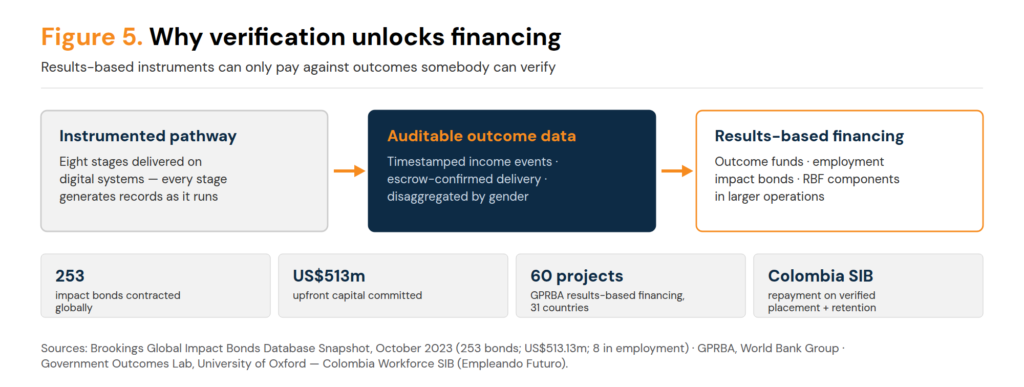
Verified outcomes are not only a methodological virtue; they are a financing precondition. A growing share of development finance is contracted against results rather than activities. The World Bank Group’s Global Partnership for Results-Based Approaches has applied results-based financing across 60 projects in 31 countries (GPRBA); globally, 253 impact bonds worth over US$513 million in upfront capital have been contracted across 40 countries, including eight in the employment sector (Brookings, 2023). The workforce case in point is Colombia’s Empleando Futuro — the first social impact bond in a developing country with government as an outcome funder — in which repayment depended on verified job placement and three-month retention, with a bonus for six-month retention: of 1,855 participants, 899 were placed in formal employment, 677 retained for three months, and 309 for six or more (Government Outcomes Lab; Brookings, 2017).
The logic runs in one direction: outcome-contingent finance can only pay against outcomes somebody can verify. A programme whose income claims rest on recall surveys cannot credibly enter a results-based contract; a programme whose income events are timestamped in an auditable ledger is financeable by design. This is the practical significance of building verification into the architecture rather than commissioning it afterwards — it converts a workforce programme from a grant recipient reporting activities into a counterparty able to contract on results. For governments and development partners exploring outcome funds, employment impact bonds, or results-based components in larger operations, the measurement layer is not administrative overhead; it is the asset.
Adapting the framework across contexts
A framework earns the name only if it transfers. The design principle that makes transfer possible is the separation of a constant core from an adaptive delivery layer: the stages, gates, results chain, and measurement architecture remain fixed, while occupational tracks, language, partner institutions, and payment integration follow each country’s reality. The reference implementation is in Jordan, where the framework is deployed through Ostathi with the Ministry of Digital Economy and Entrepreneurship under the World Bank-financed Youth, Technology and Jobs programme — the labour-market context and results to date are examined in this series’ Jordan analysis. The series’ Iraq analysis applies the same frame to a market where deployment is planned rather than live — in effect, a design brief: the stages stay constant while payment onboarding is rebuilt on Iraq’s own account, card, and wallet rails, and measurement is disaggregated by gender and governorate from the first cohort. Subsequent country analyses in this series will extend the same discipline, market by market.
Subsequent country analyses in this series extend the same discipline, market by market — most recently to digital livelihoods in Morocco, a producing economy whose missing platform layer poses the framework’s newest test.
Implications for governments and development partners
For governments, the two-thirds problem is a procurement problem before it is a pedagogy problem. Terms of reference that specify curricula and participant counts purchase activity; terms of reference that specify a results chain to income, stage-gated progression, named means of verification, disaggregated indicators, and post-programme tracer measurement purchase outcomes. The evidence reviewed here supports funding pathways rather than courses — and structuring at least part of the contract against verified results where the measurement infrastructure permits it.
For development partners and multilateral institutions, the same evidence suggests three tests to apply to any workforce investment. Does the design address multiple constraints at once — competencies, credentials, client access, payment, and support — or a single link in the chain? Is there an individual follow-up mechanism, which the systematic-review evidence identifies as a marker of programmes that work? And is there a measurement layer capable of producing outcome data that an auditor, an outcome funder, or a finance ministry would accept? Programmes that pass all three are rarer than the volume of workforce spending suggests — and the gap between the two is, on the evidence of this analysis, where most of the sector’s unrealised impact sits.
Conclusion
The evaluation literature has delivered its verdict with unusual consistency: standalone training does not convert into employment at meaningful scale; integrated, sequenced, measured pathways do — and their effects persist for a decade. What the field has lacked is not evidence but architecture: a way of building programmes in which the pathway is explicit, progression is gated, every claim has a named source of verification, and income is measured as a system event rather than a survey answer. That is what an activation framework is. The Workforce & Entrepreneurship Engine is one working expression of it, currently deployed in Jordan and designed to transfer; the argument of this analysis, however, does not depend on any single implementation. It depends on a proposition the evidence now supports from every direction: in workforce development, the framework — not the course — is the unit of impact.
Frequently asked questions
What is a workforce activation framework?
A workforce activation framework is a programme architecture that connects competency development to income generation through an explicit results chain, staged progression with entry and exit criteria, indicators with named means of verification at every stage, stated assumptions, and measurement that continues after the programme ends. It is distinguished from a training programme by what it measures: outcomes in income and employment, verified through system records rather than self-reporting.
Why do most youth employment programmes fail?
The World Bank’s Solutions for Youth Employment coalition reports that almost two-thirds of youth employment programmes fail to have any impact, largely because they address the supply side alone. The systematic-review evidence finds that intervention type matters less than design and delivery, and that programmes integrating multiple services — with participant profiling and individual follow-up — are the ones that work.
What is the difference between training and activation?
Training builds competencies; activation converts them into income. Activation requires everything that stands between a completed course and a paid client: credible credentials, a professional market presence, client access, pricing and service definition, payment channels, and support through early market entry. The evaluation evidence shows that programmes delivering training without the activation layer produce employment gains close to zero in the short run.
What is the WEE™ Framework?
The Workforce & Entrepreneurship Engine (WEE™) is a workforce activation framework developed by UniHouse and delivered through the Ostathi digital marketplace. It structures the pathway as three phases and eight stages — from outreach to sustained income — governed by the Capacity Development Evaluation Framework (CDEF) as a cross-cutting measurement layer, with verification drawn from digital systems of record rather than self-reporting. The framework reference, including the eight-stage pathway and logical framework, is published at the WEE Framework page.
Where is the framework deployed today?
The framework is currently deployed in Jordan, where Ostathi operates with the Ministry of Digital Economy and Entrepreneurship under the World Bank-financed Youth, Technology and Jobs programme. Deployment in Iraq is planned as the next stage of Ostathi’s country-by-country expansion; this series’ country analyses of Jordan and Iraq examine both markets in detail.
References
Banerjee, A., Duflo, E., Goldberg, N., Karlan, D., Osei, R., Parienté, W., Shapiro, J., Thuysbaert, B. and Udry, C. (2015). A multifaceted program causes lasting progress for the very poor: Evidence from six countries. Science 348(6236). Open-access record, MIT. https://dspace.mit.edu/handle/1721.1/97047 Accessed 9 August 2026.
Banerjee, A., Duflo, E. and Sharma, G. (2021). Long-Term Effects of the Targeting the Ultra Poor Program. American Economic Review: Insights 3(4), pp. 471–486. https://www.aeaweb.org/articles?id=10.1257/aeri.20200667 Accessed 9 August 2026.
Brookings Institution (2017). Colombia leads the developing world in signing the first social impact bond contracts. Gustafsson-Wright, E. and Boggild-Jones, I., 31 March 2017. https://www.brookings.edu/articles/colombia-leads-the-developing-world-in-signing-the-first-social-impact-bond-contracts Accessed 9 August 2026.
Brookings Institution (2023). Global Impact Bonds Database Snapshot, October 2023. https://www.brookings.edu/wp-content/uploads/2023/08/Impact-Bonds-Snapshot-October-2023.pdf Accessed 9 August 2026.
Campbell Collaboration (2017). Interventions to improve the labour market outcomes of youth: a systematic review. Review summary. https://www.campbellcollaboration.org/review/improving-youth-labour-market-outcomes/ Accessed 9 August 2026.
Card, D., Kluve, J. and Weber, A. (2018). What Works? A Meta-Analysis of Recent Active Labor Market Program Evaluations. Journal of the European Economic Association 16(3) / NBER Working Paper 21431. https://www.nber.org/papers/w21431 Accessed 9 August 2026.
Carranza, E., De Lorenzo Salvador, A., Hellebrandt, T., Koettl, J., Marguerie, A. and Rigolini, J. (2026). What Works for Work: A Guidebook to Proven and Promising Employment Solutions. World Bank. https://documents1.worldbank.org/curated/en/099012126020061187/pdf/P506693-6fa65cb1-1bb8-4afa-9ef0-66f72970af23.pdf Accessed 9 August 2026.
Datta, N., Elzir Assy, A., Buba, J., Johansson de Silva, S. and Watson, S. (2019). Integrated Youth Employment Programs: A Stocktake of Evidence. World Bank Jobs Working Paper No. 24. https://documents1.worldbank.org/curated/en/307301552636285526/pdf/135321-WP-14-3-2019-16-5-44-FINALDeliverableStocktakeofevidenceonYouthEmploymentProgramsDraftCS.pdf Accessed 9 August 2026.
Global Partnership for Results-Based Approaches (GPRBA), World Bank Group. Programme overview. Accessed August 2026. https://www.gprba.org/ Accessed 9 August 2026.
Government Outcomes Lab, University of Oxford. Colombia Workforce Social Impact Bond — Empleando Futuro. Case study. Accessed August 2026. https://golab.bsg.ox.ac.uk/knowledge-bank/case-studies/colombia-workforce-sib/ Accessed 9 August 2026.
ILO (2024). Global Employment Trends for Youth 2024: Decent work, brighter futures. News summary, 12 August 2024. https://www.ilo.org/resource/news/number-youth-not-employment-education-or-training-neet-cause-concern Accessed 9 August 2026.
Innovations for Poverty Action. The Ultra-Poor Graduation Approach. Evidence page. Accessed August 2026. https://poverty-action.org/ultra-poor-graduation-approach Accessed 9 August 2026.
J-PAL (Abdul Latif Jameel Poverty Action Lab). Using administrative data for randomized evaluations. Research resource. Accessed August 2026. https://www.povertyactionlab.org/resource/using-administrative-data-randomized-evaluations Accessed 9 August 2026.
Kluve, J., Puerto, S., Robalino, D., Romero, J. M., Rother, F., Stöterau, J., Weidenkaff, F. and Witte, M. (2019). Do youth employment programs improve labor market outcomes? A quantitative review. World Development 114, pp. 237–253. https://ideas.repec.org/a/eee/wdevel/v114y2019icp237-253.html Accessed 9 August 2026.
Kluve, J. and Puerto, S. (2017). Four ways to maximize the effectiveness of youth employment programs. World Bank Jobs and Development blog. https://blogs.worldbank.org/en/jobs/four-ways-maximize-effectiveness-youth-employment-programs Accessed 9 August 2026.
McKenzie, D. (2017). How Effective Are Active Labor Market Policies in Developing Countries? A Critical Review of Recent Evidence. World Bank Research Observer 32(2) / IZA Discussion Paper 10655. https://docs.iza.org/dp10655.pdf Accessed 9 August 2026.
OECD DAC (2002; 2nd edition 2023). Glossary of Key Terms in Evaluation and Results Based Management. https://www.oecd.org/en/publications/glossary-of-key-terms-in-evaluation-and-results-based-management-for-sustainable-development-second-edition_632da462-en-fr-es.html Accessed 9 August 2026.
AP News (2026). Ostathi, operated by UniHouse, pioneers the Middle East’s first digital infrastructure linking structured workforce development to verified income. Press release syndication, May 2026. https://apnews.com/press-release/access-newswire/ostathi-operated-by-unihouse-pioneers-the-middle-easts-first-digital-infrastructure-linking-structured-workforce-development-to-verified-income-ed072360ac5a278d7aa2802fc9be4cf8 Accessed 9 August 2026.
Reuters (2026). Ostathi, operated by UniHouse, pioneers digital infrastructure linking workforce development to verified income. Press release syndication, 7 May 2026. https://www.reuters.com/press-releases/ostathi-unihouse-digital-infrastructure-linked-workforce-development-income-2026-05-07/ Accessed 9 August 2026.
UNDG (2011). Results-Based Management Handbook: Harmonizing RBM concepts and approaches for improved development results at country level. ILO-hosted resource. https://www.ilo.org/resource/undg-results-based-management-handbook-2011 Accessed 9 August 2026.
UniHouse Global Ltd (2024–2026). WEE™ Framework documentation: Framework Overview (UH-PUB-WEE-001); Eight-Stage Implementation Pathway (UH-PUB-WEE-FLOW-001); Logical Framework — Generic Indicators and Results Architecture (UH-CTRL-WEE-LOGFRAME-001). Framework reference page. https://ostathi.com/wee-framework/ Accessed 9 August 2026.
World Bank / S4YE (2018). Digital Jobs for Youth: Young Women in the Digital Economy. Solutions for Youth Employment, September 2018. https://documents1.worldbank.org/curated/en/503651536154914951/pdf/129757-S4YE-Digital-Jobs-Report.pdf Accessed 9 August 2026.
World Bank (2023). Demand for online gig work rapidly rising in developing countries. Press release for Working Without Borders: The Promise and Peril of Online Gig Work, 7 September 2023. https://www.worldbank.org/en/news/press-release/2023/09/07/demand-for-online-gig-work-rapidly-rising-in-developing-countries Accessed 9 August 2026.
Yahoo Finance (2026). Ostathi, operated by UniHouse, pioneers Middle East digital infrastructure for verified income. May 2026. https://uk.finance.yahoo.com/news/ostathi-operated-unihouse-pioneers-middle-163000890.html Accessed 9 August 2026.
Ostathi (2026). Digital Livelihoods in Jordan. jo.ostathi.com. https://jo.ostathi.com/digital-livelihoods-jordan Accessed 9 August 2026.
Ostathi (2026). Digital Livelihoods in Iraq: The Next Learn-to-Earn Market. ostathi.com. https://ostathi.com/digital-livelihoods-iraq/ Accessed 9 August 2026.
Methodology note
This analysis synthesises peer-reviewed evaluation literature, systematic reviews, and institutional publications from the World Bank Group, ILO, OECD, UN system, and academic evaluation groups, alongside UniHouse WEE™ framework documentation (UH-PUB-WEE-001, UH-PUB-WEE-FLOW-001, UH-CTRL-WEE-LOGFRAME-001). All external sources were verified as accessible as of 9 August 2026. Findings from individual studies are reported with their original scope and vintage; where figures derive from working-paper versions of later-published studies, the citation identifies the version used. Descriptions of the WEE™ framework and the Ostathi Digital Ledger reflect company documentation and company-reported information. Figure 2 is a conceptual rendering of published findings and is labelled as such. This article is an analytical publication of the Ostathi Insights series and does not constitute an evaluation of any specific programme deployment.
August 29, 2026, 12:51 pm
[…] Kluve et al., 2019; Carranza et al., 2026). This series has set out that evidence in full in its activation framework analysis; the Moroccan corollary is direct. A training certificate does not open the individual pathway, and […]