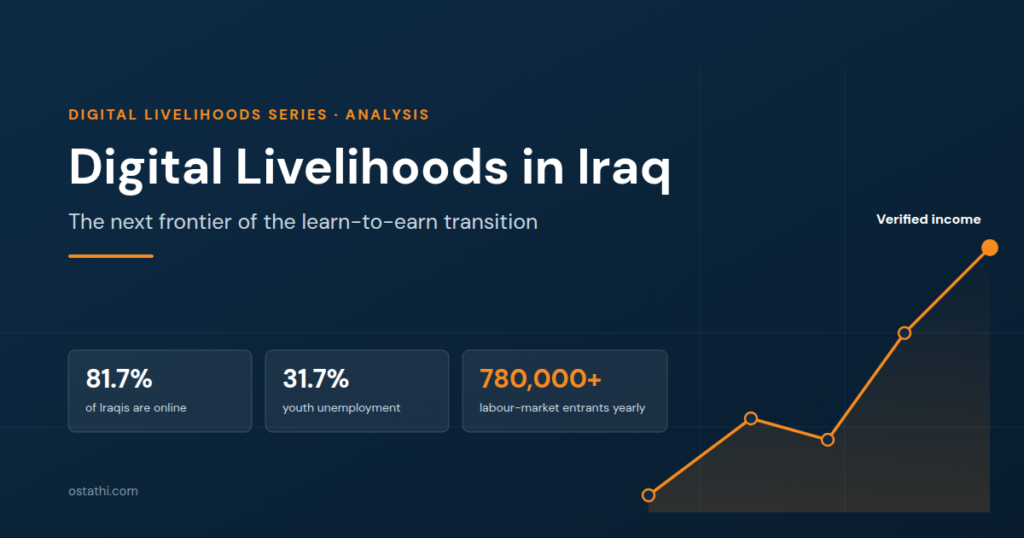
Iraq is the Middle East’s starkest test of the digital livelihoods argument: the region’s youngest large population, near-complete connectivity, an oil-funded state that cannot hire its way out of a youth bulge — and almost none of the infrastructure that converts learning into income. This analysis examines what the evidence says Iraq requires.
Iraq’s digital livelihoods question
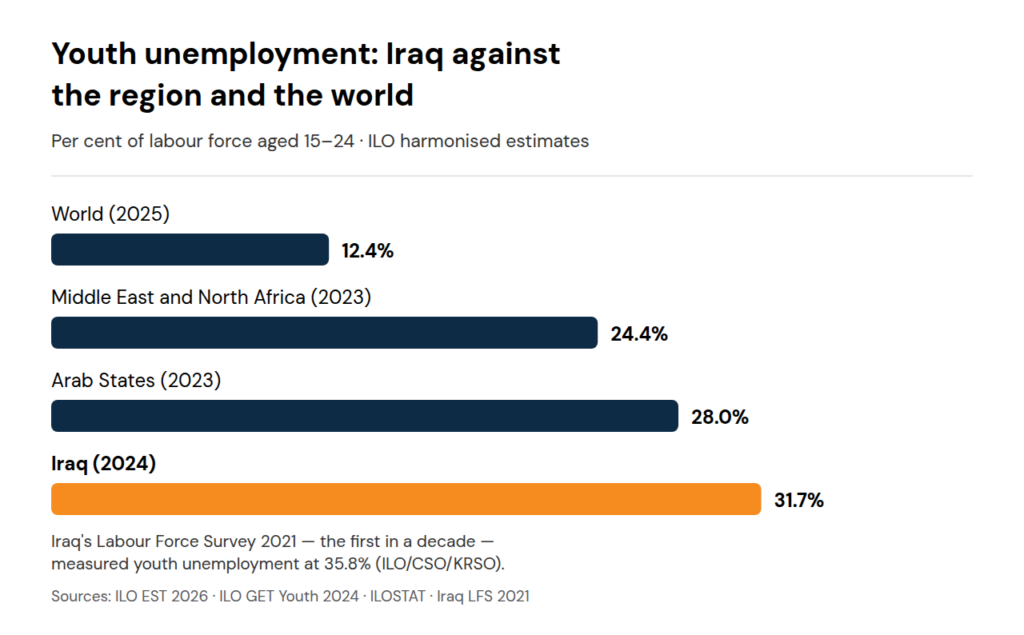
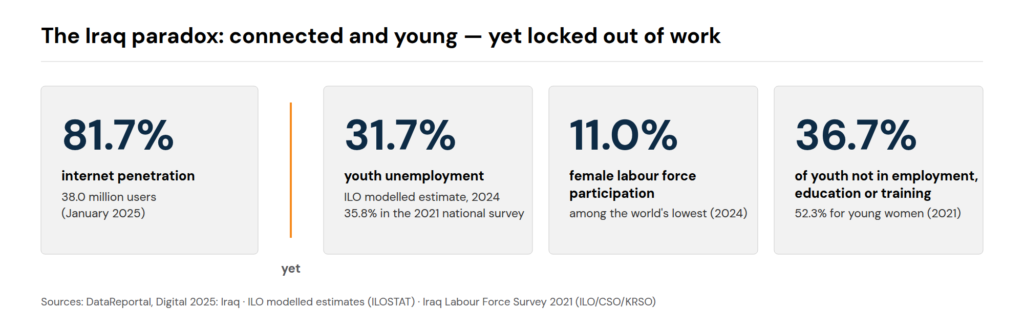
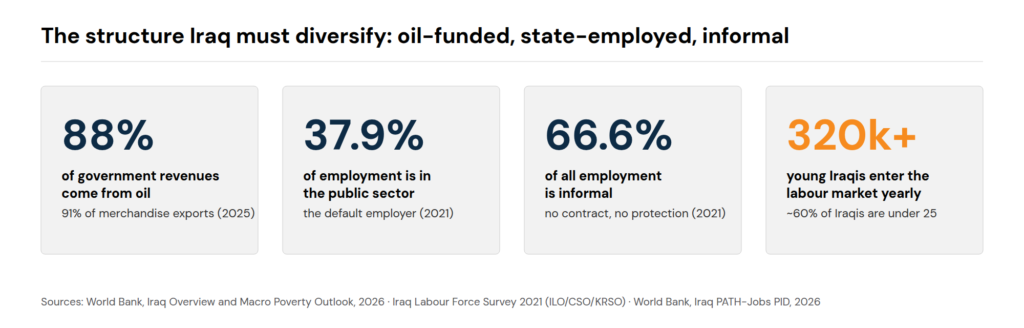
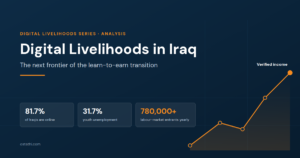
Nearly 60 per cent of Iraqis are under the age of 25, and more than 320,000 young people enter the labour market every year (World Bank, 2026). The economy they enter cannot absorb them: youth unemployment stands at 31.7 per cent on the ILO’s modelled estimate for 2024 (ILOSTAT/WDI), and Iraq’s first national Labour Force Survey in a decade, conducted in 2021, measured it at 35.8 per cent — more than three times the adult rate (ILO/CSO/KRSO, 2022). Yet the same generation is online: 38 million Iraqis — 81.7 per cent of the population — use the internet (DataReportal, 2025). Iraq poses, in its sharpest regional form, the question this series examines: what infrastructure converts digital access into digital income?
This article is the second in a series analysing digital livelihoods market by market. The first examined Jordan, where a structured learn-to-earn pathway is now in national implementation under the World Bank-supported Youth, Technology and Jobs programme — that analysis, and the evidence base behind the model, is published at Digital Livelihoods in Jordan. Here the same analytical frame is applied to Iraq: the labour market, the structural constraints, the digital turn now under way, and the infrastructure the evidence says is required.
What is a digital livelihood?
A digital livelihood is sustained, verifiable income earned through digitally enabled work — online freelancing, remote employment, digitally delivered professional services such as tutoring, translation, and consulting, or digital entrepreneurship. It is distinct from completing a digital course: a course produces a certificate, while a livelihood requires market-relevant competencies, verifiable credentials, a discoverable professional identity, access to clients, workable payment channels, and income that continues over time. Globally, the World Bank estimates 154–435 million people — between 4.4 and 12.5 per cent of the global labour force — already earn through online gig work (World Bank, 2023), with demand growing 41 per cent between 2016 and early 2023 and low- and middle-income countries generating 40 per cent of platform traffic (World Bank, 2023). That market is reachable from Baghdad, Basra, Erbil, and Mosul exactly as it is from Amman — if, and only if, the connecting infrastructure exists.
Iraq’s labour market: the starkest starting point in the region
Iraq’s Labour Force Survey 2021 — conducted by the Central Statistical Organization and the Kurdistan Region Statistics Office with the ILO, the first comprehensive national survey in a decade — quantified what a generation of Iraqis already knew. Unemployment stood at 16.5 per cent overall and 35.8 per cent among youth. Female labour force participation was 10.6 per cent, against 68.0 per cent for men — one of the lowest rates recorded anywhere in the world. More than one in three young Iraqis — 36.7 per cent — were not in employment, education, or training; among young women, over half (ILO/CSO/KRSO, 2022). The ILO’s modelled estimates show the picture persisting rather than resolving: youth unemployment of 31.7 per cent and female participation of 11.0 per cent in 2024 (World Bank WDI).
Education offers less protection than Iraqi families expect. Unemployment among Iraqis with advanced education reached 18.8 per cent in 2021 — more than double its 2012 level (World Bank WDI) — while 48 per cent of Iraqi firms cite an inadequately educated workforce as a major constraint (World Bank, 2026). Degrees are being produced; the competencies markets buy, and the pathways that connect them to income, are not.
The structural constraint: oil, state employment, and informality
Three structural facts explain why Iraq’s youth bulge cannot be absorbed by business as usual. First, the state’s income is oil: 88 per cent of government revenues and 91 per cent of merchandise exports in 2025 (World Bank, 2026). Second, the state is the default employer — 37.9 per cent of all employment is public (Iraq LFS 2021) — and the fiscal room to continue hiring is closing: the IMF projects wages and pensions absorbing a rising share of spending, and notes that the public sector’s size and benefits “create a high reservation wage” that distorts both the labour market and the education system feeding it (IMF, 2025). Third, what the private economy does generate is largely unprotected: 66.6 per cent of employment is informal (Iraq LFS 2021).
The World Bank’s diversification analysis for Iraq reached the structural conclusion years ago: growth and employment must come from sectors that do not depend on oil or public hiring (World Bank, 2020). Digitally delivered services are among the few sectors that can scale without heavy capital, reach demand beyond Iraq’s borders, and employ the educated young people the public sector cannot. The question is not whether Iraq’s diversification runs through digital work — it is whether the infrastructure exists for Iraqis to earn from it.
The demographic clock and the private-sector imperative
Iraq’s population has grown from 37.6 million in 2015 to 46.0 million in 2024, expanding at over 2 per cent a year (World Bank WDI). On the UN’s medium-variant projection it reaches roughly 52 million by 2030 and near 72 million by 2050 (UN World Population Prospects 2024), with a median age of just over 20. The employment arithmetic follows directly: the IMF expects more than 780,000 new entrants in Iraq’s labour market every year (IMF, 2025). The instrument Iraq has historically used to absorb them is exhausted. The civil service grew from 3.0 million employees in 2015 to over 4.0 million by 2024 on Ministry of Finance figures (Rudaw Research Center, 2025), and the IMF projects wages and pensions climbing from 22.0 per cent of GDP in 2024 toward 24.5 per cent by 2026 (IMF, 2025) — on oil revenues whose fiscal breakeven keeps rising. A state hiring even at its recent record pace absorbs a fraction of each year’s entrants; the model is not merely strained but arithmetically finished.
The alternative has to be private, and today it is thin: the oil sector that generates most of Iraq’s GDP employs around half a per cent of its workers (IMF, 2025), overall labour force participation is only 38 per cent, and the World Bank describes the private sector as limited in size (World Bank, 2026). What is new is the policy energy behind entrepreneurship.
The Prime Minister’s Riyada initiative, launched in March 2023, reports roughly half a million registrations and a further 1 trillion Iraqi dinar financing expansion approved in late 2025 (government-reported figures via Shafaq News, 2025); the Netherlands-funded Orange Corners Innovation Fund entered its second phase in Baghdad in December 2024 (Wamda, 2024); and a genuine ecosystem has formed around hubs such as The Station and research houses such as KAPITA, alongside the EU co-financed ProDIGI digital-economy programme (GIZ). These are necessary foundations — but ventures serving only domestic demand inherit the economy’s constraints.
Digitally delivered services change the arithmetic differently: they let Iraq’s entrants sell to demand beyond Iraq’s borders, which is precisely why livelihoods infrastructure, not entrepreneurship promotion alone, is the binding requirement.
Iraq’s digital turn is already under way
The baseline has moved faster than perceptions of Iraq. Internet use has risen from 15 per cent of the population in 2015 to over 81 per cent in 2024 (ITU via World Bank WDI); mobile connections exceed the population, 83 per cent of them broadband-capable (DataReportal, 2025). Iraqi commerce is visibly digitalising even where payments are not: online shopping is widespread but transactions still settle predominantly in cash on delivery (Access Partnership) — a reminder that connectivity converts into digital economy only as far as the payment layer allows.
Iraqi scholarship reaches the same diagnosis from within. A University of Baghdad analysis of Iraq’s digital-economy indicators between 2010 and 2022 found the e-government and internet-service indices improving but still weak, research and development spending stuck at 0.04 per cent of GDP, and the emigration of skilled workers eroding the technical base — concluding that digital technology will lift Iraqi growth only when it is applied across real economic activity, rather than left at the level of connectivity (Abdullrada & Waheeb, 2023)
Payments and banking: the hardest infrastructure is finally moving
Iraq’s starting point is stark. It is one of the most under-banked countries in the Middle East: cash dominates transactions, much of the economy has been dollarised, and three state-owned banks hold roughly 85 per cent of banking assets, much of it non-performing (US Department of State, 2025). Fewer than one in five adults held a formal account as recently as 2021 (Global Findex 2021, via GIZ), and credit to the private sector remains a fraction of the economy — 23.3 per cent of non-oil GDP in 2024 (IMF, 2025).
The reform push since 2023 is the most consequential in decades. The government mandated electronic payment systems across public agencies and businesses in 2023 (US Department of State, 2024); a November 2024 directive ordered the full transition of government payments to electronic channels (Rudaw, 2024), with the deadline now set at July 2026 (The National, 2025); the Central Bank issued Digital Payment Regulation No. 2 of 2024 with UNDP technical support (UNDP, 2024) and announced comprehensive banking-sector reforms in April 2025 (US Department of State, 2025). Salary domiciliation — moving public wages from cash to accounts and cards — now runs across dozens of banks, with the Kurdistan Region’s My Account programme alone targeting 1.2 million employees (Kurdistan Chronicle, 2024).
Movement is measurable. Government digital payment collections nearly tripled from 2.6 to 7.6 trillion Iraqi dinars between January 2023 and late 2024 (UNDP, 2024); officials report point-of-sale terminals rising from under 10,000 in 2022 to around 62,000 in 2025 and payment cards from 16 to over 21 million (government-reported figures via Shafaq News, 2025); and the independently measured Findex series shows account ownership rising from 18.6 to 30.2 per cent of adults between 2021 and 2024 (World Bank Global Findex, 2025).
A provider ecosystem is scaling on the same rails: sixteen e-payment companies are licensed by the Central Bank; Qi Card reports 11 million users, 23,000 point-of-sale terminals, and six in ten payments now made by smartphone wallet or QR (company-reported, via The National, 2025); ZainCash reports over a million users and 35 million transactions in 2024 (Forbes Middle East, 2025); NassWallet reports processing over US$1 billion and delivering biometric payments to more than 280,000 refugees; and digital-first banks have appeared. The candour of the sector’s own leadership is telling: ZainCash’s chief executive estimates Iraq remains five years behind regional peers in digital payments (AGBI, 2026).
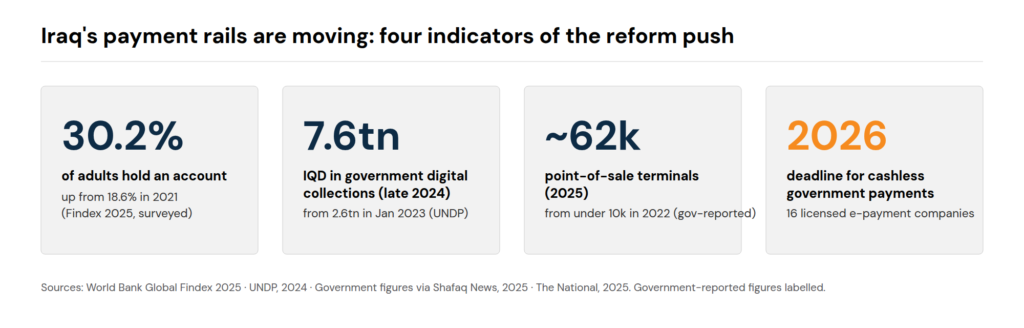
The challenges are equally documented, and they sit disproportionately on the cross-border side — exactly where digital livelihoods earn. Correspondent-banking de-risking remains severe: twenty-two Iraqi banks were barred from US-dollar transactions during 2023–24 amid anti-money-laundering pressure (Reuters via VOA, 2024), and Iraq’s first direct US correspondent relationships in decades were established only in 2023–24 (US Department of State, 2025).
The card channel itself drew scrutiny when cross-border volumes surged from US$50 million to US$1.5 billion a month before controls were imposed — allegations reported by the Wall Street Journal and US Treasury, after which Qi Card blocked over 3,000 accounts (via The National, 2025). For the individual online worker the practical consequence is blunt: PayPal does not serve Iraqi accounts, international payout services offer no direct withdrawal to Iraqi banks, and wire transfers can take two weeks (industry documentation, Iraqi Innovators).
The implication for livelihoods programming follows: domestic pay-in rails now exist and are scaling, while cross-border payout remains the binding constraint — so pathways must build payment onboarding, escrow, and verified routing into Iraq’s own accounts and wallets as core design, not an afterthought. Donor support for exactly this layer exists, including a €19.9 million EU/German financial inclusion programme running to 2026 (GIZ).
The Findex series also exposes the reform’s central weakness. The account-ownership gain to 2024 was almost entirely male: men’s ownership nearly doubled to 40.8 per cent while women’s rose only marginally to 18.8 per cent, tripling the gender gap from roughly 7 to roughly 22 percentage points (World Bank Global Findex, 2025). Financial inclusion driven by salary digitisation reaches those who already have salaries — overwhelmingly men. Reaching the other half of the population requires connecting accounts to something women do not currently have: income.
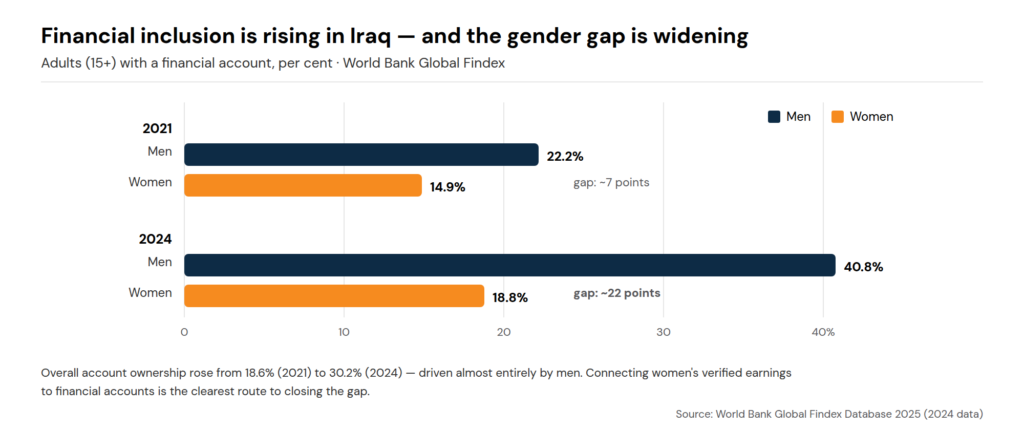
and 2024. Source: World Bank Global Findex Database 2025.
The market Iraqis can serve
What would Iraqi digital workers actually sell? The global market’s structure points to specific answers. Demand for online work is concentrated in high-income countries — 77.2 per cent of the total, led by the United States (World Bank, 2023) — which rewards differentiated, trust-verified services over commodity microtasks. Regionally, the Gulf economies are structural buyers of professional and outsourced services from Arabic-speaking suppliers. And the Arabic digital market itself is strikingly underserved: Arabic accounts for only around 0.6 per cent of website content whose language can be identified (W3Techs, 2026), against more than 400 million daily Arabic speakers (UNESCO) — an indicative gap in content production, tutoring, translation, and localisation that Iraq’s educated bilingual graduates are well placed to serve.
The occupational selection must be dynamic, because generative AI is repricing the entry rungs of this market in real time. One in four workers worldwide is in an occupation with some exposure to generative AI, with clerical tasks most exposed (ILO, 2025), and platform-level evidence shows demand for automation-prone writing tasks contracting after the arrival of large language models (Demirci, Hannane and Zhu, 2023). For a market entering late, as Iraq is, this is an advantage disguised as a threat: programmes designed now can be built AI-integrated from the first cohort, aimed at the services where verified human competency, local context, and client relationships carry the premium — rather than retrofitting programmes designed for a market that no longer exists.
Why training alone will not close Iraq’s gap
Iraq is not short of training initiatives — the government operates its own entrepreneurship programmes, and international partners fund digital-skills programmes across the country: the EU co-financed ProDIGI programme promoting employment in Iraq’s digital economy (GIZ), the ILO’s PROSPECTS partnership working on inclusion of refugees and displaced Iraqis (ILO PROSPECTS), and UNIDO’s Austrian-funded Digital Technology Skills to Enhance Employability in Iraq programme, training displaced and host-community youth in networks, cybersecurity, and entrepreneurship (UNIDO via UN Iraq, 2025).
The constraint is what the global evidence predicts: programmes that end at certification rarely end in income. Across more than 200 evaluations of active labour market programmes, short-run employment effects average close to zero (Card, Kluve and Weber, 2018), and government training programmes at scale typically raise employment by around two percentage points or less (McKenzie, 2017). In Iraq the certificate-to-income distance is wider still: the graduate faces an informal labour market, a public-sector queue, a thin formal private sector — and until recently, no way to be paid by a client outside their city, let alone outside the country.
The evidence behind this design logic is examined in depth in this series’ workforce activation framework analysis.
The infrastructure Iraq requires
What converts Iraq’s assets — youth, education, connectivity, modernising payment rails — into livelihoods is the same architecture the Jordan analysis details, adapted to Iraqi conditions. Mobilisation that reaches beyond the connected elite, with screening against market demand rather than open enrolment. Competency development aligned to what buyers of Arabic and bilingual digital services actually purchase — tutoring, translation, administrative support, digital marketing, data services — with AI tools embedded from the start, since generative AI is already compressing the routine entry-level tasks globally (ILO, 2025).
Verifiable credentials and discoverable professional profiles, because an unknown freelancer from Basra competes on trust. Payment integration with Iraq’s own rails — the accounts, cards, and wallets now scaling — so that earnings settle at home, formally, building the financial history informality denies. And measurement that verifies income rather than assuming it, at the individual level, disaggregated by gender, tracked beyond programme exit.
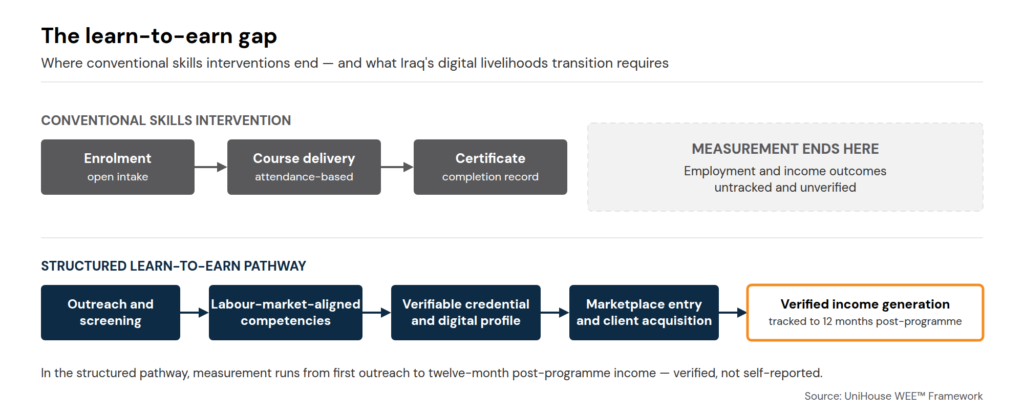
Iraq’s transition requires delivery — and verification — through to sustained income. Conceptual
framework. Source: UniHouse WEE™ Framework.
For women, this architecture is not an inclusion feature but the core proposition. Remote digitally delivered work is one of the few participation channels compatible with the constraints that hold female participation at 11 per cent; women already represent 56 per cent of online gig workers across the Middle East and North Africa, the highest share of any region (World Bank, 2023). A pathway that moves an Iraqi woman from competency to verified income deposited in her own account addresses, in one architecture, among the region’s lowest female labour force participation rates and a rapidly widening financial inclusion gap.
What the Jordan implementation demonstrates
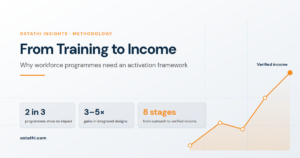
The reference implementation for this architecture is running now in Jordan. Under the Ministry of Digital Economy and Entrepreneurship, within the World Bank-supported US$200 million Youth, Technology and Jobs programme, the Ostathi platform operates a structured eight-stage pathway — the UniHouse Workforce and Entrepreneurship Engine (WEE™) — from outreach and screening through competency development and credentialing to marketplace entry and verified income generation, measured throughout by the CDEF™ evaluation framework and tracked to twelve months post-programme (WEE™ Framework). Jordan’s state news agency records the Ministry’s framing of the platform as “a scalable digital learning ecosystem that supports employment, entrepreneurship and integration into freelance and platform-based economies” (Petra — Jordan News Agency, 2026). Its mobilisation layer received more than 1,000 applications within five days of activation. The full analysis is published at Digital Livelihoods in Jordan.
The element of the Jordan implementation most relevant to Iraq sits at the payment layer — and it is the model’s distinctive innovation. The Ostathi Digital Ledger operates as an integration layer across regulated national payment providers — in Jordan, MEPS Jordan and HyperPay — holding each payment in escrow until service delivery is confirmed, settling earnings from clients inside or outside the country into local bank accounts and mobile wallets, and recording every transaction as a timestamped, auditable income event in the participant’s individual ledger.
Income, in this architecture, is never self-reported; it is generated, recorded, and verified inside the system — producing the audit-grade outcome data that results-based financing requires. It is telling what drew international attention when this architecture was documented: coverage syndicated globally via Reuters and AP News and carried by Yahoo Finance centred not on the platform but on the measurement design — the first digital infrastructure in the region linking structured workforce development to verified income.
For Iraq, where the freelancer payout gap is the binding constraint documented above, this is precisely the pattern an Iraqi deployment would replicate on Iraq’s own rails: the providers change; the escrow-and-ledger architecture does not.
The design principle that matters for Iraq is platform-agnostic delivery: the eight stages and the measurement architecture stay constant, while the delivery layer — occupational tracks, language, payment providers, partner institutions — adapts to each country’s reality. Jordan’s deployment runs on Jordanian rails; an Iraqi deployment would run on Iraq’s.
From analysis to implementation
The country-platform model examined above was designed for adaptation: the stages and the measurement architecture stay constant while occupational tracks, language, partner institutions, and payment integration follow each country’s reality. An Iraqi deployment of that model is planned as the next stage of this series’ geography, and this analysis is, in effect, its design brief — occupational selection from Iraqi and regional demand data, delivery adapted to Iraqi connectivity, payment onboarding built on Iraq’s scaling account, card, and wallet rails, and measurement disaggregated by gender and governorate from the first cohort. Consistent with the standard applied throughout this series, its results will be reported as verified figures with dates, not projections.
The series’ geography has since extended westward: the Morocco analysis examines a producing economy with the opposite starting point — world-rank exports, but no platform layer for its individual producers.
Implications for government and development partners in Iraq
For the institutions now shaping Iraq’s employment agenda — the government’s entrepreneurship and digitisation initiatives, the World Bank’s education-to-employment operations, the ILO’s decent-work programming, and bilateral digital-economy programmes — the evidence reviewed here suggests five design principles. Fund pathways, not courses: Iraq’s constraint is conversion, not certification.
Anchor programmes on verified income, using the payment digitisation the state is already mandating as the verification layer employment programmes have always lacked. Disaggregate by gender from day one, and treat women’s verified earnings as the primary instrument for closing a financial inclusion gap that salary digitisation alone is widening. Build on Iraq’s own payment rails, so every programme participant becomes a formally banked earner. And select occupations dynamically, because the AI-era evidence shows the entry rungs of digital work are being repriced faster than programme cycles.
Conclusion: Iraq’s opening
Iraq enters the digital livelihoods era with the region’s most difficult starting conditions and, precisely because of them, its strongest case for structured pathways. The state cannot hire the 320,000 young Iraqis arriving each year; the informal economy cannot protect them; and the connectivity they already have will not, by itself, pay them. What the evidence supports is infrastructure: market-led competency development, verifiable professional identity, client access, payment integration with Iraq’s modernising rails, and measurement that proves income rather than asserting it. That infrastructure now has a working regional reference in Jordan — and Iraq, on the evidence assembled here, is where it matters next.
Frequently asked questions
What are digital livelihoods, and why do they matter for Iraq?
Digital livelihoods are sustained, verifiable incomes earned through digitally enabled work — freelancing, remote services, tutoring, translation, digital entrepreneurship. They matter for Iraq because the conventional absorption channels — public sector hiring and the informal economy — cannot employ a population where nearly 60 per cent are under 25, while 81.7 per cent of Iraqis are already online.
How high is youth unemployment in Iraq?
Iraq’s Labour Force Survey 2021 measured youth unemployment at 35.8 per cent — more than three times the adult rate; the ILO’s modelled estimate for 2024 is 31.7 per cent. Among Iraqis with advanced education, unemployment reached 18.8 per cent in 2021.
What is the biggest barrier between digital skills and digital income in Iraq?
The conversion infrastructure: verifiable credentials, discoverable professional profiles, client access, and — historically hardest in Iraq — payments. That constraint is easing: account ownership rose from 18.6 to 30.2 per cent of adults between 2021 and 2024, electronic payments are government-mandated, and national wallet providers are scaling. A learn-to-earn pathway connects earnings to those rails.
Why are women central to Iraq’s digital livelihoods agenda?
Female labour force participation in Iraq is around 11 per cent — among the world’s lowest — and Iraq’s financial inclusion gender gap tripled between 2021 and 2024. Remote digitally delivered work is one of the few participation channels compatible with existing constraints, and across the Middle East and North Africa women already form 56 per cent of online gig workers — the highest share of any region.
Is Ostathi operating in Iraq today?
Not yet. Ostathi currently operates in Jordan, where it is deployed with the Ministry of Digital Economy and Entrepreneurship under the World Bank-supported Youth, Technology and Jobs programme. An Iraq platform is planned as the next stage of Ostathi’s country-by-country expansion, designed around Iraq’s own labour market, connectivity conditions, and payment rails.
References
Access Partnership (2025). E-commerce in Iraq: exploring untapped markets in the Middle East. https://accesspartnership.com/opinion/e-commerce-in-iraq-exploring-untapped-markets-in-the-middle-east/ Accessed 13 July 2026.
AGBI (2026). ZainCash CEO: Iraq is 5 years behind in digital payments. June 2026. https://www.agbi.com/banking-finance/2026/06/zaincash-ceo-iraq-is-5-years-behind-in-digital-payments/ Accessed 13 July 2026.
Card, D., Kluve, J. and Weber, A. (2018). What Works? A Meta-Analysis of Recent Active Labor Market Program Evaluations. Journal of the European Economic Association 16(3) / NBER Working Paper 21431. https://www.nber.org/papers/w21431 Accessed 13 July 2026.
DataReportal / Kepios (2025). Digital 2025: Iraq. February 2025. https://datareportal.com/reports/digital-2025-iraq Accessed 13 July 2026.
GIZ. Financial inclusion for economic prospects and integration (Iraq), 2020–2026. https://www.giz.de/en/projects/financial-inclusion-economic-prospects-and-integration Accessed 13 July 2026.
Forbes Middle East (2025). The Middle East’s Fintech 50 — ZainCash Iraq. https://www.forbesmiddleeast.com/lists/the-middle-easts-fintech-50-2025/zaincash-iraq/ Accessed 13 July 2026.
GIZ. Promoting employment in the digital economy in Iraq (ProDIGI). BMZ/EU, 2023–2026. https://www.giz.de/en/worldwide/143842.html Accessed 13 July 2026.
ILO (2025). Gmyrek, P. et al. Generative AI and Jobs: A Refined Global Index of Occupational Exposure. ILO Working Paper 140. https://www.ilo.org/publications/generative-ai-and-jobs-refined-global-index-occupational-exposure Accessed 13 July 2026.
ILO (2026). Employment and Social Trends 2026. January 2026. https://www.ilo.org/publications/flagship-reports/employment-and-social-trends-2026 Accessed 13 July 2026.
ILO, CSO and KRSO (2022). Iraq Labour Force Survey 2021. Published July 2022. https://www.ilo.org/publications/iraq-labour-force-survey-2021 Accessed 13 July 2026.
ILO (2022). Iraq and ILO launch first national labour force survey in a decade. News release, 5 July 2022. https://www.ilo.org/resource/news/iraq-and-ilo-launch-first-national-labour-force-survey-decade Accessed 13 July 2026.
ILO. PROSPECTS partnership — Iraq country page. https://www.ilo.org/projects-and-partnerships/projects/partnership-improving-prospects-forcibly-displaced-persons-and-host/countries/iraq Accessed 13 July 2026.
ILOSTAT. ILO modelled estimates database (Iraq: youth unemployment; labour force participation), via World Bank WDI. https://data.worldbank.org/indicator/SL.UEM.1524.ZS?locations=IQ Accessed 13 July 2026.
IMF (2025). Iraq: 2025 Article IV Consultation — Country Report. July 2025. https://www.imf.org/en/-/media/files/publications/cr/2025/english/1irqea2025001-source-pdf.pdf Accessed 13 July 2026.
IMF (2025). Iraq: Selected Issues — Country Report 25/184 (labour market chapter). https://www.imf.org/-/media/files/publications/cr/2025/english/1irqea2025002-source-pdf.pdf Accessed 13 July 2026.
Iraqi Innovators. How to get paid as an online freelancer in Iraq. Industry documentation, updated 2024. https://iraqtech.io/how-to-get-paid-as-an-online-freelancer-in-iraq/ Accessed 13 July 2026.
Kurdistan Chronicle (2024). Banking on change: Iraq’s Tawteen and the KRG My Account programme. https://kurdistanchronicle.com/babat/2966 Accessed 13 July 2026.
McKenzie, D. (2017). How Effective Are Active Labor Market Policies in Developing Countries? World Bank Research Observer 32(2). https://academic.oup.com/wbro/article/32/2/127/4064175 Accessed 13 July 2026.
Ostathi (2026). WEE™ Framework — Workforce and Entrepreneurship Engine. https://www.ostathi.com/wee-framework/ Accessed 13 July 2026.
Ostathi Jordan (2026). Digital Livelihoods in Jordan: From Learning to Verified Economic Participation. https://jo.ostathi.com/digital-livelihoods-jordan Accessed 13 July 2026.
Petra — Jordan News Agency (2026). Digital Economy Ministry Introduces Platform to Advance Skills, Employment. 26 February 2026. https://petra.gov.jo/bin/index.php/en/news/digital-economy-ministry-introduces-platform-to-advance-skills-employment Accessed 13 July 2026.
Rudaw (2024). Iraq sets deadline for full transition to electronic government payments. 4 November 2024. https://www.rudaw.net/english/middleeast/iraq/04112024 Accessed 13 July 2026.
Rudaw Research Center (2025). Expansion of Iraq’s public sector: how many new civil servants were appointed last year? September 2025. https://rudawrc.net/en/article/expansion-of-iraqs-public-sector-how-many-new-civil-servants-were-appointed-last-year-2025-09-22 Accessed 13 July 2026.
Shafaq News (2025). Iraq fast-tracks digital finance in push for global standing (government-reported figures). July 2025. https://shafaq.com/en/Economy/Iraq-fast-tracks-digital-finance-in-push-for-global-standing Accessed 13 July 2026.
Shafaq News (2025). Iraq boosts Riyada youth employment loans with $700M expansion (government-reported figures). December 2025. https://shafaq.com/en/Economy/Iraq-boosts-Riyada-youth-employment-loans-with-700M Accessed 13 July 2026.
The National (2025). Iraq’s cashless push gaining pace, but much more needs to be done. 1 October 2025. https://www.thenationalnews.com/business/banking/2025/10/01/iraqs-cashless-push-gaining-pace-but-much-more-needs-to-be-done-fintech-boss-says/ Accessed 13 July 2026.
UNDP (2024). The Turning Point: Iraq’s Leap into the Digital Economy. Press release, December 2024. https://www.undp.org/arab-states/press-releases/turning-point-iraqs-leap-digital-economy Accessed 13 July 2026.
UNIDO via UN Iraq (2025). Digital Empowerment in Iraq: Bridging Education, Employment, and Entrepreneurship. 20 October 2025. https://iraq.un.org/en/303623-digital-empowerment-iraq-bridging-education-employment-and-entrepreneurship Accessed 13 July 2026.
UN World Population Prospects 2024 (medium variant), Iraq projections, as compiled by Worldometer. https://www.worldometers.info/world-population/iraq-population/ Accessed 13 July 2026.
US Department of State (2025). 2025 Investment Climate Statements: Iraq. https://www.state.gov/reports/2025-investment-climate-statements/iraq/ Accessed 13 July 2026.
VOA / Reuters (2024). Iraq bans 8 local banks from US dollar transactions. February 2024. https://www.voanews.com/a/iraq-bans-8-local-banks-from-us-dollar-transactions/7470566.html Accessed 13 July 2026.
Wamda (2024). Netherlands commits $2.7 million to IVP for Iraqi entrepreneurs. December 2024. https://www.wamda.com/2024/12/netherlands-commits-2-7-million-ivp-iraqi-entrepreneurs Accessed 13 July 2026.
Reuters (2026). Ostathi, operated by UniHouse, pioneers digital infrastructure linking workforce development to verified income. Press release syndication, 7 May 2026. https://www.reuters.com/press-releases/ostathi-unihouse-digital-infrastructure-linked-workforce-development-income-2026-05-07/ Accessed 13 July 2026.
AP News (2026). Ostathi pioneers the Middle East’s first digital infrastructure linking structured workforce development to verified income. Press release syndication, May 2026. https://apnews.com/press-release/access-newswire/ostathi-operated-by-unihouse-pioneers-the-middle-easts-first-digital-infrastructure-linking-structured-workforce-development-to-verified-income-ed072360ac5a278d7aa2802fc9be4cf8 Accessed 13 July 2026.
Yahoo Finance (2026). Ostathi, operated by UniHouse, pioneers Middle East digital infrastructure for verified income. May 2026. https://uk.finance.yahoo.com/news/ostathi-operated-unihouse-pioneers-middle-163000890.html Accessed 13 July 2026.
US Department of State (2024). 2024 Investment Climate Statements: Iraq. https://www.state.gov/reports/2024-investment-climate-statements/iraq Accessed 13 July 2026.
World Bank (2020). Breaking Out of Fragility: A Country Economic Memorandum for Diversification and Growth in Iraq. https://www.worldbank.org/en/news/press-release/2020/09/30/breaking-out-of-fragility-how-iraq-can-turn-economic-diversification-into-growth-and-stability Accessed 13 July 2026.
World Bank (2023). Working Without Borders: The Promise and Peril of Online Gig Work. https://openknowledge.worldbank.org/entities/publication/ebc4a7e2-85c6-467b-8713-e2d77e954c6c Accessed 13 July 2026.
World Bank (2025). Global Findex Database 2025 (Iraq: FX.OWN indicators). https://data.worldbank.org/indicator/FX.OWN.TOTL.ZS?locations=IQ Accessed 13 July 2026.
World Bank (2026). Iraq Overview and Macro Poverty Outlook. April 2026. https://www.worldbank.org/en/country/iraq/overview Accessed 13 July 2026.
World Bank (2026). Iraq PATH-Jobs: Program for Advancement of Transformational Higher Education for Jobs — Project Information Document (P510893). January 2026. https://documents1.worldbank.org/curated/en/099012726053535114/pdf/P510893-244470fe-c811-48ba-aa37-16e06b5621ab.pdf Accessed 13 July 2026.
World Bank WDI. Iraq indicators: SL.UEM.1524.ZS; SL.TLF.CACT.FE.ZS; SL.UEM.NEET.ZS; SL.UEM.ADVN.ZS; IT.NET.USER.ZS; SP.POP.TOTL. https://data.worldbank.org/country/iraq Accessed 13 July 2026.
Abdullrada, M. F. and Waheeb, B. A. (2023). The Role of Digital Economy in Iraqi Economic Growth for the Period of 2010–2022 (Analytical Study). Journal of Economics and Administrative Sciences, 29(138), pp. 96–112. University of Baghdad.
All URLs verified live 23 July 2026. Company-reported figures (Qi Card, ZainCash, UniHouse case studies) are attributed as such in the text. Iraq unemployment series are labelled by source and year throughout — the LFS 2021 survey, ILO modelled estimates, and World Bank macro framing are distinct methodologies and are never mixed.
August 29, 2026, 12:50 pm
[…] to Morocco the frame developed across this series — in Jordan, where the model is deployed, and Iraq, where connectivity outran infrastructure — and extends it. A digital livelihood is an income […]