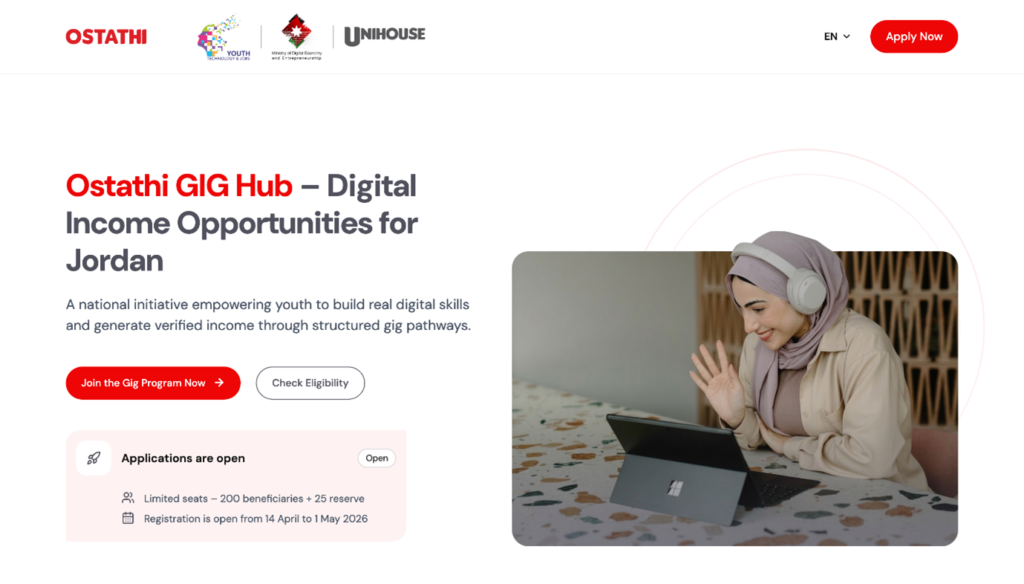
Jordan has taken a decisive step toward building an inclusive, digitally enabled workforce. The Ministry of Digital Economy and Entrepreneurship (MoDEE) has partnered with UniHouse Jordan to deploy the Ostathi platform as a structured, national-scale pathway from digital skills to verified income — funded under the World Bank Youth, Technology and Jobs (YTJ) Project.
This is not another training programme. It is a system-level shift that integrates digital skills development, competency certification, marketplace onboarding, and real income generation into one unified, auditable platform — built for the standards that institutions like the World Bank, IFC, and EBRD require.
The Partnership: What Is Being Deployed
Ostathi operates as a marketplace-driven economic activation system. Deployed under Jordan’s national digital economy agenda, the platform brings together:
- Digital outreach and applicant funnel systems
- Online training across high-demand skills tracks
- Competency-based assessment and CDEF-governed certification
- Marketplace onboarding and service listing tools
- Integrated payment infrastructure for verified income
The programme targets youth with limited labour market access, with a minimum 50% female participation target — including Syrian women in Jordan — making it one of the region’s most inclusion-focused digital employment initiatives.
Already Operational: Early Results
The programme moved rapidly from design to delivery. Within the first days of launch, Ostathi’s digital outreach infrastructure generated over 1,000 applications — confirming the platform’s ability to mobilise large, qualified applicant pools even in constrained labour markets.
Selected participants are enrolled in structured 20-hour training tracks including Digital Marketing, Translation, Digital Tutoring, Administrative Support, and Accounting. Every participant also completes an AI Tools for the Digital Economy module and a Business Foundations module — equipping them to operate as independent economic actors from day one.
National and Regional Media Coverage
The partnership has been recognised across regional media as a landmark moment for Jordan’s digital economy:
- Jordan News: “Jordan Takes a National Step Toward Digital Employment”
- Roya News: “MoDEE Expands Ostathi to Boost Digital Skills and Reduce Unemployment”
- MENAFN: “Digital Economy Ministry Introduces Platform to Advance Skills and Employment”
Why This Model Is Different
Traditional workforce programmes stop at training completion. Ostathi does not. Through the WEE™ (Workforce & Entrepreneurship Engine) framework developed by UniHouse, beneficiaries move through eight structured stages — from initial outreach all the way through to verified income generation and long-term livelihood growth.
Crucially, income is not self-reported. It is tracked through platform transaction data — providing the kind of auditable, results-based evidence that development finance institutions require for programme reporting and disbursement.
What Comes Next: Regional Expansion
Jordan is the first deployment — not the last. Ostathi is expanding across Morocco, Egypt, Saudi Arabia, and Iraq, building what UniHouse describes as the Middle East’s largest structured gig economy framework. Each market deployment replicates the same system: outreach, training, certification, marketplace entry, and verified income.
For governments and institutions looking to invest in digital employment at scale, the Jordan model provides a live, replicable proof of concept — one already aligned with international development standards and operating in a real-world national context.
📖 Read the full WEE™ framework: From Training to Income — UniHouse