The global gig economy is growing. According to the World Bank, digital platform work is one of the fastest-growing sources of employment across emerging markets — with particular potential in the MENA region, where youth unemployment rates consistently exceed 25% and female labour force participation remains critically low.
Yet most gig economy interventions fail to deliver sustainable outcomes. The reason is structural: they provide access to platforms without providing the skills, certification, professional identity, or income infrastructure needed to succeed on them. The result is high dropout, low earnings, and no verifiable impact data for donors or governments.
What a Structured Gig Economy Framework Actually Requires
Based on international development experience across MENA, Sub-Saharan Africa, and South Asia, effective gig economy frameworks must address five core system gaps:
- Demand-led skills alignment — training must map to what clients on digital marketplaces are actively buying, not general digital literacy
- Professional identity and certification — freelancers need verifiable credentials, not just course completion records
- Marketplace access and promotion — skills alone do not generate income; structured marketplace onboarding is essential
- Payment infrastructure — particularly in MENA, payment fragmentation and regulatory barriers prevent income from reaching workers
- Outcome verification — income must be tracked through platform data, not self-reported surveys
The WEE™ Framework: A Structured Response
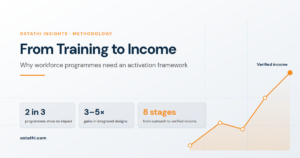
The Workforce & Entrepreneurship Engine (WEE™), developed by UniHouse and operationalised through the Ostathi platform, directly addresses all five gaps through an eight-stage implementation pathway spanning three phases: Mobilise, Build, and Activate.
Unlike generic platform access programmes, WEE™ connects outreach, skills development, certification, marketplace onboarding, and income verification into a single, integrated system — with every stage producing measurable, digitally-tracked outputs.
Live Proof: Jordan’s National Deployment
WEE™ is not a theoretical model. It is currently deployed at national scale in Jordan through the Ministry of Digital Economy and Entrepreneurship (MoDEE) under the World Bank Youth, Technology and Jobs (YTJ) Project.
Early results are instructive: over 1,000 applications were generated within five days of launch — demonstrating that structured, digitally-enabled outreach can rapidly mobilise large applicant pools even in constrained labour markets. Participants are trained across five high-demand skill tracks, certified through the CDEF framework, and onboarded directly onto the Ostathi marketplace to begin earning.
The programme has been covered by Jordan News, Roya News, and MENAFN as a landmark moment for Jordan’s digital economy strategy.
Inclusion by Design: Gender and Vulnerability
A structured gig economy framework must also embed inclusion — not treat it as a reporting afterthought. The WEE™/Ostathi model includes a minimum 50% female participation target, gender-disaggregated tracking through the CDEF evaluation layer, and specific design features for vulnerable populations such as Syrian women in Jordan.
This aligns directly with the inclusion frameworks of IFC, EBRD, and UN Women — and provides the disaggregated data those institutions require for evidence-based reporting.
Replication Across the Region
Following Jordan, Ostathi is expanding into Morocco, Egypt, Saudi Arabia, and Iraq — building what UniHouse describes as the Middle East’s largest structured gig economy framework.
For development finance institutions and governments looking for scalable, evidence-based digital employment models, the WEE™ framework provides a replicable architecture — one that is already operational, already producing verifiable outcomes, and already aligned with international development reporting standards.
🔗 Read the full WEE™ framework article on UniHouse