Across emerging and frontier markets, workforce development programmes face a persistent structural failure: training is delivered, certificates are issued — and then nothing happens. Beneficiaries remain unemployed. Donors receive self-reported outcomes with no way to verify them. Governments are left without evidence of economic impact.
The Workforce & Entrepreneurship Engine (WEE™), developed by UniHouse and deployed through the Ostathi platform, was built to solve this problem. It is a structured, eight-stage implementation framework that moves beneficiaries from outreach to verified income — with every stage digitally tracked and auditable.
Three Phases, Eight Stages
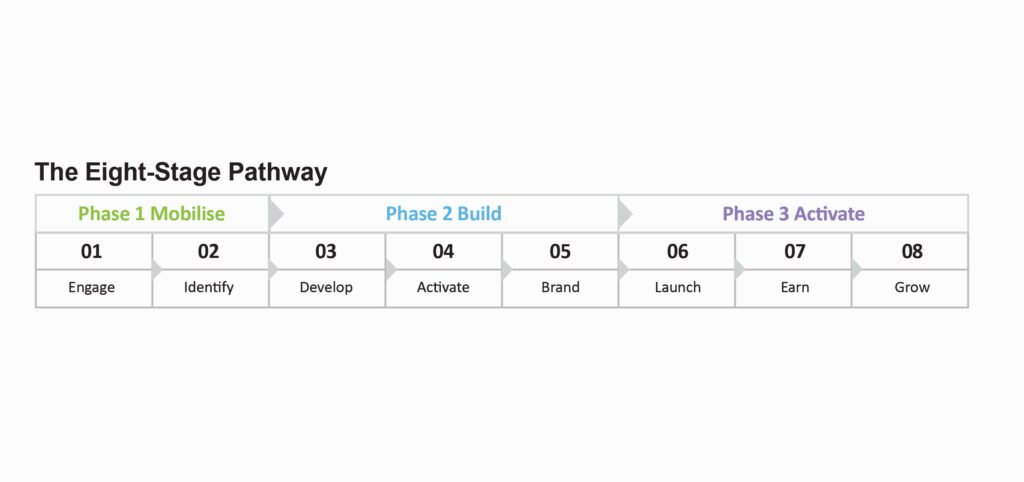
The WEE™ framework organises workforce activation into three phases, each with defined objectives and measurable outputs.
Phase 1: Mobilise (Stages 1–2)
Stage 1 — Engage: Targeted digital outreach campaigns, funnel-based application systems, and mobilisation tools. In the Jordan MoDEE / World Bank YTJ deployment, this stage generated over 1,000 applications within five days.
Stage 2 — Identify: Structured intake assessments, data segmentation, and cohort allocation. Beneficiaries are not randomly selected — they are systematically screened against eligibility, readiness, and market alignment criteria.
Phase 2: Build (Stages 3–5)
Stage 3 — Develop: Market-aligned digital skills training across tracks such as Digital Marketing, Translation, Administrative Support, and Accounting. Each track is assessed through the CDEF (Capacity Development Evaluation Framework).
Stage 4 — Activate: Entrepreneurship readiness training, service definition, and gig economy orientation. Beneficiaries learn how to price their services, attract clients, and operate as independent economic actors.
Stage 5 — Brand: Verifiable certification, creation of a professional Ostathi digital profile, and professional identity establishment. This is the transition point from learner to market-ready service provider.
Phase 3: Activate (Stages 6–8)
Stage 6 — Launch: Marketplace onboarding on Ostathi, service listing activation, and initial promotion campaigns.
Stage 7 — Earn: Client acquisition, verified income generation through the platform, and access to mentorship and employer-linked internship opportunities.
Stage 8 — Grow: Income scaling, repeat client engagement, and the transition to sustainable, independent livelihoods tracked at 3, 6, and 12 months post-programme.
Why Results-Based Design Matters
WEE™ is structured around a logical results chain aligned with World Bank, IFC, and EBRD reporting frameworks:
- Input → Activity → Output → Outcome → Impact
- Every stage has defined indicators
- All results are digitally tracked and auditable
- Income is verified through platform transaction data — not self-reporting
This is critical for results-based financing models, where donor disbursements are tied to verifiable outcomes. The WEE™ framework provides the infrastructure to make that possible.
CDEF: The Measurement Layer
Running across all eight stages is the CDEF (Capacity Development Evaluation Framework) — a cross-cutting measurement system that provides:
- Competency assessment at every stage
- Real-time performance tracking
- Gender-disaggregated reporting
- Longitudinal outcome monitoring at 3, 6, and 12 months
CDEF ensures full compliance with IFC, EBRD, and UN Women gender inclusion and results-based reporting frameworks — making Ostathi-powered programmes audit-ready from the first day of delivery.
📖 Read the full WEE™ article on UniHouse: From Training to Income